Tuesday, September 1, 2020

Expansion - Randolph Industries Part II

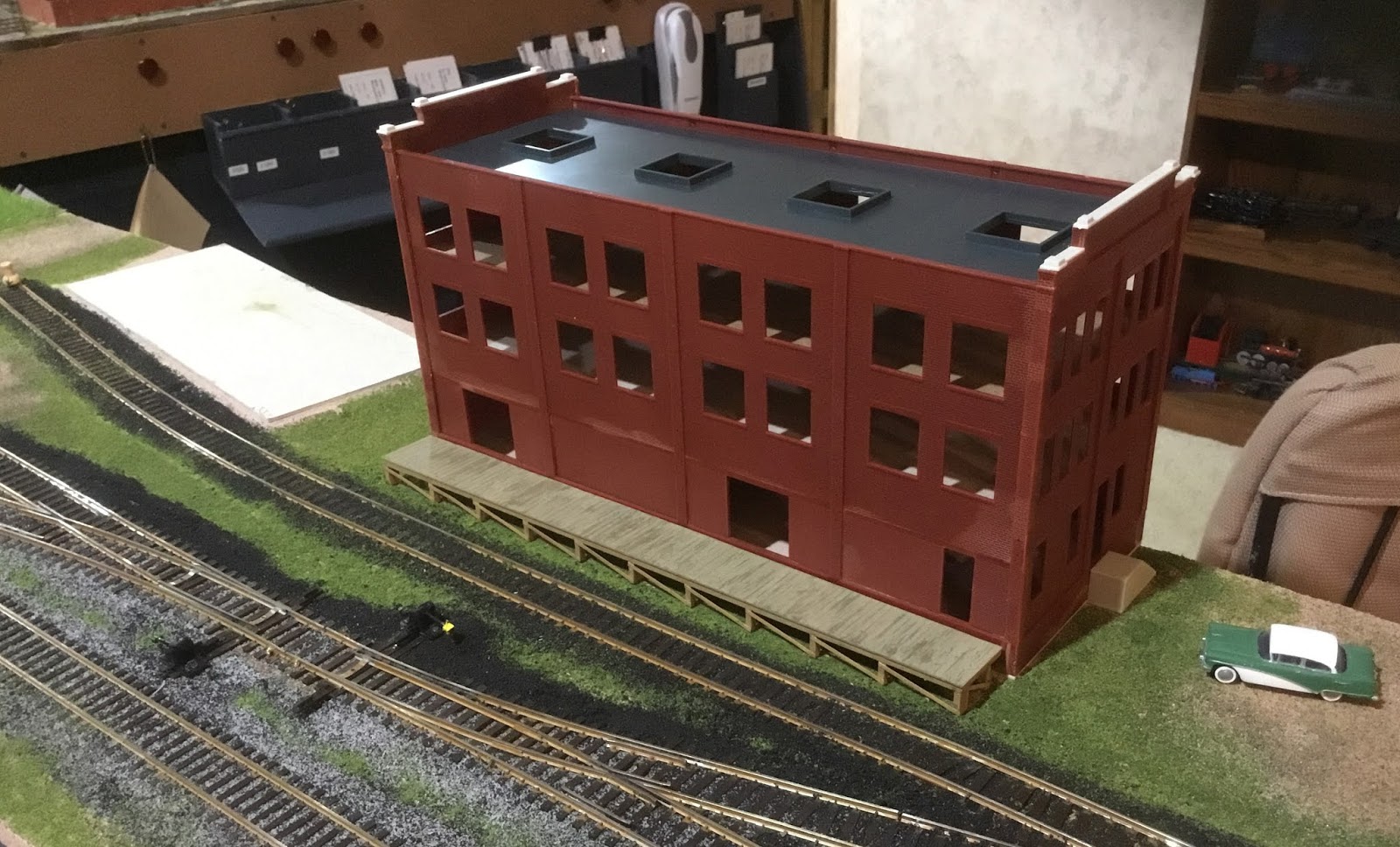
With three of the industries in Randolph finished except for a few minor details, I began to build General Tire And Rubber, the final industry.  I decided to use a Timberline II  kit, a two story brick warehouse, kit 1004-2495, that arrived as a surprise package from my good friend George Toman.   When I asked George about the surprise package he explained the kit was left to him by a friend that had recently passed.  He now had two warehouse kits since he already had the kit.  When he read my blog post on changes to Tunnel City in which I said I was going to add the Randolph expansion, he sent the Timberline II warehouse kit guessing I might be able to use it in Randolph.  He guessed right.

When I saw the the photo of the built warehouse on the box cover with the unique exterior trusses and dock hoist, I knew I wanted to build the warehouse kit to house a customer in Randolph.  My excitement to build the warehouse kit took a hit when I opened  the kit to exam the contents.  The Timberline II warehouse kit contents are building sides and ends printed on ten ply card,  thin cardboard ( named RR board in the kit) for roof and floors, scale lumber, embossed brick paper, white metal castings of windows, doors and other detail parts, drawings of each side and an isometric drawing 1/2 HO scale with letters on the drawing to indicate the part involved and numbers to indicate the step in the instructions.


Photo of warehouse on Timberline II box cover.
( click on this on any photo to enlarge )


Drawings in kit.


Some kit contents and cardboard template to assemble warehouse.


After looking at the kit drawings of the warehouse I knew the sides were the length I needed and one end was the correct width; however, the other was not as I needed it to be shorter.  The kit drawings were for a building with a rectangle footprint and my allotted space footprint  for General Tire And Rubber was for a convex quadrilateral referred to as a trapezoid building footprint.  I would need to make a cardboard footprint of the building to assemble the warehouse in the modified shape I wanted after I positioned the dock.

Before I started the General Tire And Rubber building I started with the trackside dock.  I found the kit dock scribed decking; however, I did not want to cut all the wood posts and framing from the scale lumber to build the sub structure.  Therefore, I looked through my saved building parts from prior kits and found plastic molded dock framing with posts attached.  The plastic framing was for a longer dock then the kit dock drawing which had the dock only the length of the building.   I liked the longer length as I wanted to connect the hoist dock on end of the building with the one on trackside.  I glued the wood dock decking to the plastic framing with Testors tube cement.  Of all the glues I use, I still find Testors tube cement is the best for attaching wood to plastic.   To locate the dock, I determined the dock distance from the track with a National Model Railroad Association (NMRA) track gauge and set it in place.


Plastic dock posts and framing with kit wood decking.


With dock in place, I used cardboard to make a footprint template for General Tire And Rubber building to help with assembly.  The  square attached to the trapezoid footprint is for space to be occupied by the hoist dock on the end of the building. 


Cardboard footprint template I made to help warehouse assembly.


I began the build of the warehouse by cutting out the sides, ends and roof elevator shaft enclosure from the printed cards with a Xacto knife with a #11 blade followed by cutting out the windows and doors from the cut out sides and end.  Embossed brick paper was glued to the card sides and ends with rubber cement.   Openings for the windows and doors were made by making a vertical cut from the interior in the middle of the brick paper covering the opening and a cut across the top and bottom of the each opening with Xacto knife with #11 blade. The brick paper was now folded and glued to the inside ( interior side) of the card openings.  I changed from rubber cement to Elmers white glue for this task.   Three buildings sides, the long side blank wall, trackside wall and short hoist wall had the kit scale lumber foundation glued to them and then they were glued together with  Elmer’s white glue. 


Three walls glued together after window and
 door openings made and walls glued to foundation.


The brick paper covered sides were colored with Primsacolor pencils:  tuscan red, PC937 and dark umber, PC947.  Pan Pastel neutral grey, # 820.5, was applied over the colored brick walls with a cotton swab.   Again, the brick paper was colored with the Prismacolor pencils.  Pilasters on the building, kit lumber with brick paper covering three sides, were installed and colored as other brick described above.  


Bricks colored with Prismacolor pencils and
Pan Pastel Neutral Grey.


Interior bracing provided in the kit was cut to fit with a Northwest Shortline chopper and installed.  Floors and roof cut from heavy cardboard to replace the thin RR card provided in the kit were installed.   Since floors were tightly fitted to the building walls, a cut was made in their length to allow removal after doors and windows installed.


Interior bracing and removable bottom floor installed.


Cardboard floors installed in the interior.
Front wall with windows and doors not yet cut out sits in front.


I continued the build of the building by completing the front wall of the building even if it would face the backdrop when in place.  Wood kit parts were cut and fitted for the stone trim.  The roof was covered with 320 black wet/dry sandpaper attached with rubber cement.  The elevator shaft enclosure walls were covered with the brick paper and the roof with the same sandpaper as the main roof.   Roof trusses, a unique feature of building, were glued up from the kit wood parts modified to the new roof footprint size. 

The dock and dock hoist, a second unique feature of the kit, were built next.   I cut the scale kit lumber per drawings for the dock posts, framing and attached the scribed wood decking.  In my scale lumber supply I used matching scribed wood to complete the trackside dock decking and the connection I wanted from the hoist dock to it.  On the front of the trackside dock I installed the post bracing in a different pattern then used on the Food Producers building next door.  The kit white metal castings for the hoist frame were installed and painted with Model Master steel, # 1780.


Front wall, roof with trusses, end dock and hoist and installed.


Back wall, roof with trusses, end dock and hoist view. 


Dock bracing on the two building docks is a different pattern.


Now I sprayed the windows and doors using a Color-Place rattle can with a fast dry paint color called fire red.  While  the windows were drying I installed steps from the parts box on the end of the trackside dock and stained the docks with FloquiI Oak (S123) Flo-Stain and dirty Dio-Sol thinner.  The brick wall portions showing above the roof were covered with brick paper and colored to match the exterior brick walls.  I finished the exterior roof trusses by adding the wire to represent the truss rods and installed the kit white metal castings for the rod plate and blots.  A roof access hatch was cut from kit lumber, painted to match windows and doors and installed.

Once the windows and doors were dry I installed them in the opening from the interior with the exception of the office doors installed from the outside.  The wood lintels for windows and doors and the window sills were cut from the scale lumber with NWSL chopper and installed with Elmers white glue and painted PollyScale Depot Buff.  The diamonds at the top of the pilasters are white metal castings provided in the kit.


Docks are stained. Windows with lintels and stiles
 and doors with lintels installed in front wall. Wood
trusses have details added.


The trackside dock roof  was next.  I installed the kit provided roof brackets, white metal castings , on the building and attached the wood roof.  I decided to cover the wood roof with Campbell Scale Models corrugated aluminum roofing, #801.  I attached the Campbell corrugated roofing with barge cement.  The corrugated roofing was painted with Model Master steel #1780.


Trackside dock wood roof installed.  


After the wood trackside  roof  was installed I stained the roof trusses with Floquil Oak stain and dirty Dio-Sol paint thinner while the glue set.  It was the same method I used to stain the decks except I also used some of sediment "gunk" from the bottom of the Dio-Sol bottle to make the trusses darker than the docks.


Trackside dock roof with corrugated roofing installed.


I assembled the block and tackle for the dock hoist.  I replaced the kit piano wire to be used for the chain with 50 links of brass chain gifted me by Bill Welch. I also added the metal chimney and vent details to the roof.


Block and Tackle with chain added to pulleys installed on hoist.


Final roof details added and block and tackle painted.


With. General Tire And Rubber building now complete I wanted to get the backdrop installed.  The backdrop is 1/8 inch masonite finished on one side.  I cut masonite backdrop sections 18 1/2 inches wide from 2 x 4  feet pieces purchased at the local home improvement store.  The finished railroad side is painted sky blue and the back side to match the layout room area.  The backdrop is installed with fourteen inches above the benchwork and four and one-half inches under the benchwork fascia.  The four and one-half inches of backdrop under the benchwork fascia rest on the bottom screws attaching the fascia and are secured with the top fascia screws which also pass through it.
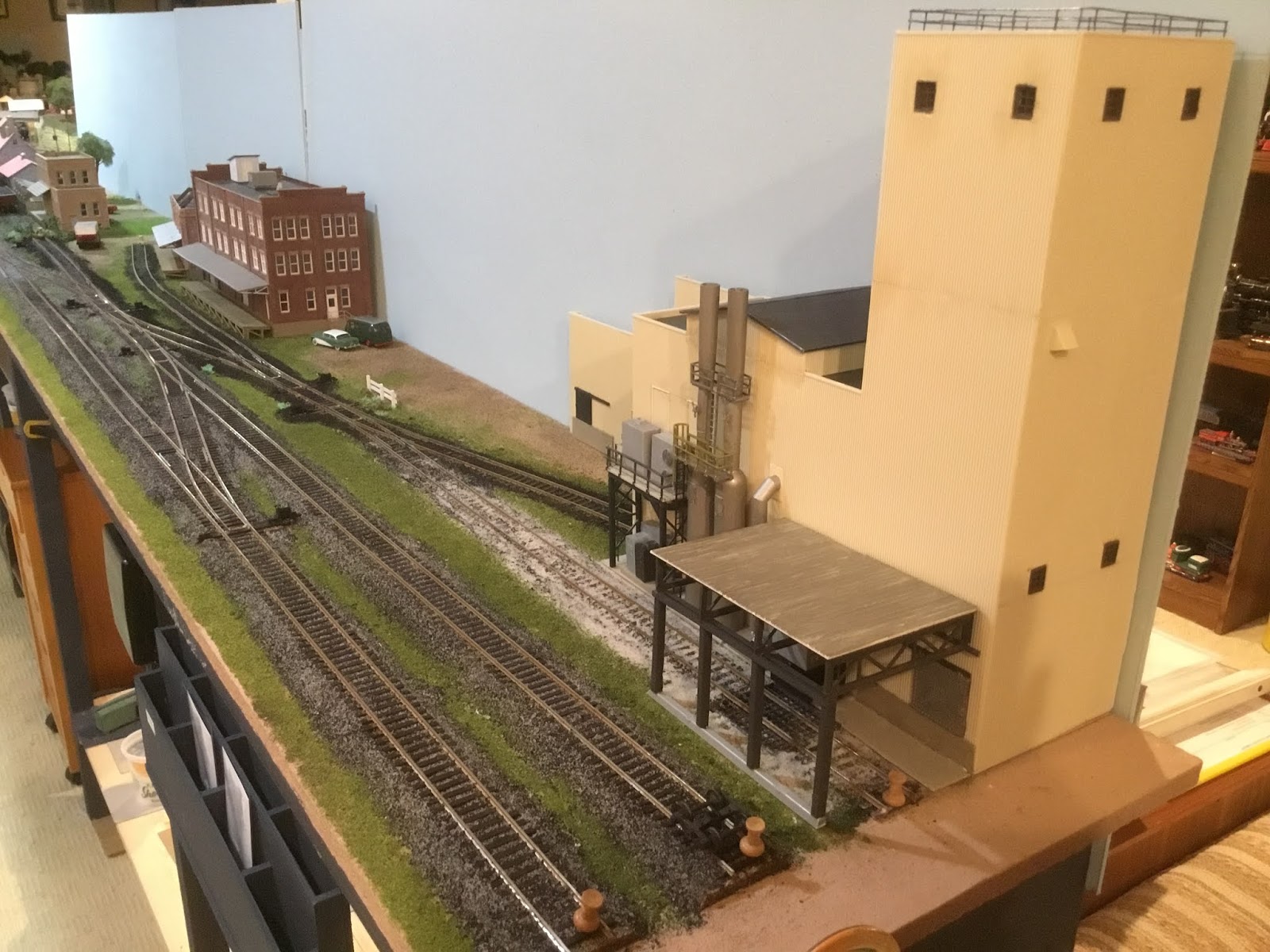


Backdrop painted sky blue installed behind Randolph
as viewed from the Randolph Glass Plant end.


Backdrop painted sky blue installed behind Randolph
as viewed from the Wildung Team Track end.


Backdrop is inserted resting on bottom fascia screws.  Top
fascia screws also pass through backdrop to hold it in place.


While the painted backdrop was drying I built and installed the end of road guard  on the end of the road next to the track for the road serving the Food Producers and Randolph Anchor Glass.  I  built the end of road guard using dimensions provided on drawing in NMRA data sheet, Streets And Roads, D2g, issued April 1957.


End of road guard installed at track.


My Randolph expansion is ready for the Minneapolis & Northland Railroad Company to begin serving the new customers gained.  And, it is ready to exchange cars with the  Chicago Great Western connection there.  With a card box, phone and drink holder installed on the Randolph fascia, all that remains is to makeup the necessary waybills to create the customer traffic for operating sessions.


Not a lot of freight cars yet as waybills
 for the Randolph industries need to be made.


Phone, card box and fold up drink up holder
 installed on Randolph fascia.


Work table and throttle holder added to fascia. 
And,  a few new cars coming to the railroad.


Another, “Thank You” to George Toman for providing the Timberline II warehouse kit to build the General Tire And Rubber building and Bill Welch for the 50 links per inch brass chain used for the block and tackle on the Timberline II hoist.  


Thank You for taking time to read my blog.  You can share a comment in the section below if you choose to do so.  Please sign your comment with your name if you choose to leave one.  Please share the blog link with other model railroaders.
Lester Breuer


Tuesday, August 25, 2020

Expansion - Randolph Industries, Part I

With the Randolph expansion benchwork, track work and basic scenery done, I began working on replacing cardboard rectangles representing industries with the final industries.  I began with the easy one first - the Wildung Team Track.  The remaining industries are kit bashed or modified kit structures.
I said the Wildung team track is easy as in Randolph no dock required so only fine shifted sand from a local road in my area and some sifted grey black dirt ( shifted black dirt from a local park baseball field home plate area) both applied with wet water ( Elmers white glue 25%,  tap water 75% and a few drops of liquid dish washing soap).  I put down the wet water from the Elmer’s glue bottle and use a throw away brush to to spread it in the area I will cover with the sand and dirt.  I first apply the sand with a coffee strainer and tea strainer and then a little dirt here and there with the only tea strainer.  I added Woodland Scenics blended grass and a few bushes at end of track to complete the scene for now.  I will put down static grass such as on the left side of the photo below at a later time.


Wildung Team Track
( click on this or any photo to enlarge)


Tools for adding basic scenery


The next industry, Food Producers, a little more difficult as a structure was needed for customer to occupy.  I chose the Walthers Cornerstone Trackside Post Office, kit 933-4063, for the structure.   I first assembled the dock.  I removed the boards that enclosed the bottom and added strip wood bracing to the posts.  The dock being plastic was hand painted with PollyScale Depot Buff.  Once dry the dock was brushed with Floquil Oak (S123) Flo-Stain.  Again once dry, a coat of dirty thinner gunk, the residue that collects on the bottom of the bottle filled with Dio-Sol ( I mix my own as Dio-Sol is out of production) used to clean brushes after using Floquil or other solvent based paint, was applied.  The basic building was assembled per instructions with the exception of exchanging the front and rear wall for the orientation I wanted on the railroad.


Walthers kit used for Food Producers.


Food Producers basic building and dock


At this point, I moved on to getting the basic structure in place for Randolph Anchor Glass Plant.   I chose the Walthers Cornerstone Kraft Mill, kit 933-3902, for the materials to kit bash the Anchor Glass Plant.   The  prototype for the kit bash was the Shakopee Anchor Glass Plant just outside of Shakopee in the industrial park where I grew up.  Of course, my Randolph space required using selective compression and using only the key features of the prototype.


Aerial view of Anchor Glass Plant in Shakopee
Industrial Park


Walthers kit used for Anchor Glass Plant kit bash.


 I cut, fitted and glued together the kit walls or parts of kit walls to get the basic structure.  Evergreen strip styrene was used where roof support was needed.  I did add a freight car loading entrance not on the prototype.  Just a feature I added as I wanted to have one building on the railroad that allowed spotting of freight cars inside.


Anchor Glass Plant kit bashed basic building.


Basic building  of Randolph Anchor Glass Plant.


Next I installed removable roofs on Randolph Anchor Glass Plant.  I now could proceed to complete work on the two buildings.  In this case, it was nice to have the two buildings to work on at the same time as when I tired of work on one or I was waiting for glue, etc. to set I could work on the other.  I went back to the Food Producers building and added removable interior floors and walls that I made using heavy cardboard.  The middle floors are cut/split in the middle to allow removal after doors and windows were installed.


Randolph Anchor Glass Plant roofs installed.


Food Producers interior floors


I painted the doors and windows attached to cardboard with masking tape with a rattle can using Rust-Oleum Gloss Protective Enamel.   Once dry the windows were installed and the kit window glazing was installed using Formula 560 Canopy glue.  On the exterior the window lintels were hand painted Polly Scale Depot Buff.  


Food Producers windows spray painted 


With windows installed, the roof was covered with black #320 wet/dry sandpaper, fitted and installed.    I did not like the roof sky lights on this building so I added roof details I liked and thought were more appropriate.   I scratchbuilt the “dog house” from Pikestuff wall parts  left over from another project to allow access to other roof mechanical items.  The other roof items came from Walthers Cornerstone Roof Details kit, #933-3733.


Food Producers roof with kit sky lites.


Food Producers with changes made to roof.


Now the building was ready for its exterior finish.  I applied a coat of hydrocal tinted with dry tempera paint pigment.  When dry, I added the kit roof dock which was hand painted Model Master #1780 steel.  A color I am going to miss with Testors removing Model Master paints from the market.


Food Producers with colored hydrocal finish applied.


Time to get back to the Anchor Glass Plant details.  A nice prototype feature was that many of the details were on individual concrete slabs sitting on a concrete slab the length of the building allowing me to build the side details as modules.


Shakopee Anchor Glass Plant with various details
on individual bases. 


First, a unloading grate for unloading sand in hoppers was installed in the track and the canopy was built from some trusses from the parts box, Evergreen #274 I-Beam and sheet styrene, and kit sprues for posts and base posts are attached to.  The furnace stacks were made using marker portion for the bottom and the lower barrel from a ball point pen turned upside down for the exhaust stack with an Evergreen styrene tube connecting the two pieces. Next, the air exhaust blower module next to it was built with styrene tubes and the blade hub from an helicopter model for the blower.


Unloading canopy and furnace stack started.


Basic furnace stacks and exhaust pipes with blower and
AHM door and concrete dock added under canopy.


I installed the small windows in the tower next.  The small windows came from my left over windows and doors parts box.  Following window install, I built the gable roof portion behind the furnace stacks of the glass plant to add character to the model.  I added the maintenance platforms to the furnace stacks.  The remaining details on scratch built styrene stands were made from parts in the Walthers Cornerstone Roof Details kit, Walthers Styrene Steps & Ladders kit, #1602 and below on concrete slab AHM detail parts.  Finally I added the section of the Randolph Anchor Glass Plant to the left of this building.


Small windows installed on tower of  Anchor Glass Plant.


All details including platform railings, ladders and unit next to dock
door under canopy for the side of Anchor Glass Plant completed.


Randolph Anchor Glass Plant windows
 and  additional section added.

The Anchor Glass Plant still has details that I want to add such as the leg on the roof, weathering and the maybe the unit on the gable roof section if there before 1955.  I will add these when I need another break from building freight cars.  And, I need to add the photo backdrop behind the plant and other structures.  That, will happen when I will go back next spring to photograph and use the photos to create.

The last structure for Randolph will be General Tire And Rubber I will cover in Part II.  And, I will also cover adding  a backdrop for the new Randolph expansion in Part II.


General Tire And Rubber building  will replace the
last cardboard rectangle on the siding beyond
Food Producers.  


Thank You for taking time to read my blog.  You can share a comment in the section below if you choose to do so.  Please sign your comment with your name if you choose to leave one.  Please share the blog link with other model railroaders.
Lester Breuer


Wednesday, July 29, 2020

M&N Expansion - Randolph Benchwork And Trackwork

Time to take a break from building freight cars to work on an expansion to the Minneapolis & Northland Railroad Company (M&N).  The expansion began with the changes to Tunnel City, Phase One and Two,  I described in a prior published blog.  The major change in the first expansion was adding a  mainline to be able to reach  the new town of Randolph.  The benchwork for Randolph was  Phase Three and the track work with minimal scenery Phase four.

At the end of Phase Two I showed a plan for the future Randolph expansion.  The expansion to Randolph was to have benchwork six feet long, fourteen inches wide, with a possible future flip-up section one foot long.  I continued to review the plan to see if there might be a better way to layout the location of the new industries and Chicago Great Western interchange.  I finally decided it was better to swap the location of the Chicago Great Western interchange and team track.


Original and modified track plan.
(Click on this or any image to enlarge)

With a plan for Randolph ready, I purchased the lumber, number two pine and one side finished 5/8” plywood, for the benchwork at my local lumber yard.  The homasote for the expansion was obtained from a friend, Jeff Rundgren.  The new benchwork, six feet long and fourteen inches wide, is old school L-Girder construction.  I like the L-Girder construction as it is stable, has excellent noise level and the short L-Girders can easily be moved at any time during or after construction is complete.  The reason being the short L-Girders are secured in place with only two coarse thread drywall screws from the lower long L-Girder and are only holding the plywood and homasote town base with two coarse threaded drywall screws that can easily be removed.  The homasote was attached to the plywood base with nails driven at various angles to prevent future movement of the homasote.  A storage shelf added to the benchwork also provides benchwork stability.


L-Girder benchwork with shelf being added.


The new Randolph benchwork was built to be movable on removable furniture moving sliders to allow moving the benchwork to another storage location after an operating session.  Therefore, construction of the Randolph benchwork, completed in another area of the railroad area, was moved to its location during an operating session using the removable furniture sliders purchased at a home improvement store.  The benchwork once in position is secured to the existing railroad with clamps placed on the legs.


Randolph benchwork moved to location for operating session.
Note the furniture sliders next to base of legs.


Now the track work could begin.  I began placing a mix Shinohara code 100 and Walthers code 83 nickel sliver track on the benchwork according to the plan.  I marked track centers to draw layout lines to locate cork roadbed and track location directly on the homasote.


Layout of the track begins.


The layout of the track work and the industries, currently cardboard rectangles, progressed rapidly. 


Track layout progress quickly.


With layout lines drawn, I proceeded to put down the cork roadbed with small finishing nails.  The HO scale cork roadbed was placed under mainline (track one from edge) and track two under the CGW interchange and Wildung team track ( truck near it) on the other end.  If I had N scale cork roadbed on hand I would have used it under track two to make the transition to industry tracks located directly on the homasote easier.  The transition to the industry track was done with cork cut from sheet cork and cardboard.  Ties on turnouts had to be cut and track slightly bent to make a smooth transition. 


Cork roadbed is installed.


Transition from cork roadbed to homasote.


Following the install of cork roadbed, the track was spiked in place on the cork roadbed or homasote.  I use spikes, installed in every sixth tie, to attach commercial track.  Yes, spiking the track does add time to putting the track down; however, in my opinion well worth the time, to provide excellent operation for years to come.  I do not use glue as track nails allow easy pull up and reuse of track for relocation if necessary.  Holes in the ties for track spikes are drilled in every sixth tie using a drill bit mounted in #8050 Dremel tool.  I find it amazing how many track gauges and tools one can use to install cork roadbed and track.


The number of tools used can be amazing.


After track was put down any missing ties were installed.  Next the rail sides were hand painted with Floquil Rail Brown, R7, paint.  Once track painting was done and dry Caboose Industries ground throws provided by Gary Wildung were installed.  Finally, the gaps are cut in the track with a cutting disk mounted in a Dremel tool.  Later the gaps are filled with styrene filler and 5 minute epoxy. After epoxy is set styrene filler is filed to track profile.


Track work is ready for wiring and ballast.  Note the back industry
track was curved to allow more space at Wildung Team Track.


With the track work done I began the wiring.  The wiring provides the least fun for me when adding new trackage to the railroad.  Before I start to add wires,  I attach shower curtain rings to the long L-Girder with Romex plastic wire staples to hold the bus wire, any other wires for lighting, etc. and Digitrax Loconet cables.  I use shower curtain rings to hold the wires as they can be opened and closed to add additional wires at any time.  The bus wire was run, holes drilled for track feeders and track feeder wires were added.  Track feeders are soldered to the track and bus wire.  Yes, soldering is slower than wire connectors; however, for me reliable on other track work on the railroad since 1974.


Track wiring is held in shower curtain rings.
Note clamps on legs holding Randolph in place
 for work sessions and operating sessions.


Once wiring is installed the testing of the wiring and track is done with my “Cleaner” train.  The “Cleaner” consists of locomotive, box car and caboose have track cleaning sliders made of Masonite mounted on them that will catch on any track work gaps or turnout frogs that are not smooth.  If the gap or turnout gap is not smooth, a file is used to make it smooth.  Of course, if wiring is not correct the train stops running and wiring has to be corrected.  Well, it could be a power routing turnout not thrown correctly.


"Cleaner" train is run to check track is smooth running.
Cleaning pads should not catch on electrical gaps or frogs.


Once wiring and track is tested the homasote is painted with a tan latex paint to seal the homasote to prepare it for scenery.  Next the benchwork is painted with a latex black to seal the wood.  Finally a five inch fascia is added that may or may not be painted.


Homasote painted with a tan latex.


Painting of benchwork has begun.


Fascia installed and benchwork painting finished.


I consider track ballasting an element of scenery.  The mainline ballast I use is a mix of new and used foundry sand obtained for me by a friend who works at a Minneapolis foundry. The new foundry sand color is white and used foundry sand color is black.  Siding tracks are ballasted with the black foundry sand to represent cinder ballast.  I use wet water, a mix of 25% white glue, 75% water, and a few drops of dish soap added, to secure the ballast.  I like this method of attaching the ballast because it is very easy to remove via wetting if removal is necessary.


Randolph track laid, ballasted and some ground cover added.


During the ballasting process I also have a cooking spice shaker filled with Woodland Scenics blended turf to cover grass areas between tracks.  The grass may be the final scenery or the base for static grass to be added later.


Ballast in coffee cans, wet water in Elmers glue container
and ground foam shaker are on shelf below benchwork.


Now the fun provided by running trains on the Randolph trackage can be had in future operating sessions.  Yet there is more work to be done and that of course is the addition of other scenery including ground cover, backdrop and structures.  The addition of structures, the home of future customers as Food Producers and Randolph Anchor Glass Plant to be served by the Minneapolis & Northland Railroad Company, The Lakeland Route, “Serving Today, Shaping tomorrow.”   I will cover the addition of the remaining items in Phase Five blog.


Randolph benchwork, track and basic scenery finished.


I want to say, “Thank You.” to Jeff Rundgren and Gary Wildung for their help with the Randolph expansion. 


Thank You for taking time to read my blog.  You can share a comment in the section below if you choose to do so.  Please sign your comment with your name if you choose to leave one.  Please share the blog link with other model railroaders.
Lester Breuer