Tuesday, June 16, 2020

Union Refrigerator Transit Line 95503 leased to M&St.L

With the McGregor Co-op Creamery in Northfield, Minn. on my Minneapolis & Northland Railroad Company needing more refrigerators cars for shipping products I wanted to add a few more reefers to the fleet.  In the to build cabinet no resin reefer kits, only three Branchline Trains and several Accurail kits available.  Of the three Branchline Trains kits I picked Union Refrigerator Transit Lines (URTX) 95503, kit #1220, purchased at the local hobby shop in 2004.  I had purchased the car because it had the Minneapolis & St. Louis herald showing the car was leased to the M&St.L.

Prototype URTX 95503 was a 40 -foot, 2 inch refrigerator built in 1925 by American Car & Foundry with wood side and ends.  The car had steel underframe with fishbelly center sill.  The car was assigned to series 95000 to 95599 with Association Of American Railroads Class designating letters “RS”.  The cars were painted yellow orange with red ends and roof and black underbody.  A color  photo of car URTX 4975 showing this paint scheme can be found in Refrigerator Car Color Guide by Gene Green (Morning Sun Books, Inc. 2005).

URTX 95503,  Author collection.
(click or tap on this or any image to enlarge)


I began the build with the underbody.  First the cross bearers and cross ties were inserted into the center sill sides to create the underframe.  Next, the kit train line pieces were replaced with a train line made with .018” floral wire.  The coupler pockets were cut off with a Xacto knife handle with a #18 blade.  Coupler pads and bolster center plates were drilled and tapped for 2-56 screws. Kadee #262 narrow gearboxes with Kadee #148 whisker couplers were installed with Fastenal 3/16” screws. Kit trucks, ARA cast steel with spring plank, with InterMountain 33” metal wheel installed, were installed with Fastenal 1/4” screws.  Kadee #208 .015” thick fiber washers were installed to obtain proper coupler height. The car was weighted to 3.8 ounces with tire weights and the underbody was installed into the car body.


Couplers, trucks and train line installed.


Rather than finishing the underbody I applied the kit ladders to the sides and ends.  On the roof I installed the hatch boxes for type A (standard type), the  longitudinal running board and end support brackets and the roof brake shaft bracket.  After installing the running board support bracket  on the “B” end I installed a Sunshine Models resin retainer valve from the parts box. The install of the roof brake shaft bracket and retainer valve at this time allowed me to easily identify the “B” during the remainder of the build.


Ladders and retainer valve installed.


Hatch boxes and brake shaft roof bracket installed.


Next I installed the end sills in the kit and grab irons I bent from Tichy Train Group (Tichy) #1101, .010” diameter phosphor bronze wire (PBW) on the ends and sides.  I used a #79 drill to cleanup manufacture drilled holes prior to install.  On the ends I installed eye blots I bent from Tichy #1101, .010” diameter PBW for the top mounted uncoupling levers.


B end with grab irons and eye bolts
for uncoupling levers installed.


After installing the grab iron on the sides, I installed A-Line #29000, style A, sill steps in  holes drilled with a #76 drill.  I added the door latch to complete side details.


Grab irons and sill steps installed.


Grab irons, sill steps painted and door latch unpainted installed.


Back to the roof to install style A (standard type) roof hatches and hatch latches.   To complete roof work, roof corner grab irons I bent from Tichy #1101, .010” diameter PBW with Yarmouth Model Works eye bolts without shoulder for corner supports were installed.


Hatch covers and roof grab irons installed.


Onto the remaining  “B” end details.   A retainer line and brackets, Tichy #1100, .008” diameter PBW were installed.  I used a #80 drill bit to drill the holes for the retainer line brackets.  The kit brake shaft, .015” wire, with kit brake wheel was installed.  To finish the “B” end work, uncoupling levers and brackets were bent from Tichy #1101, .010" diameter PBW.
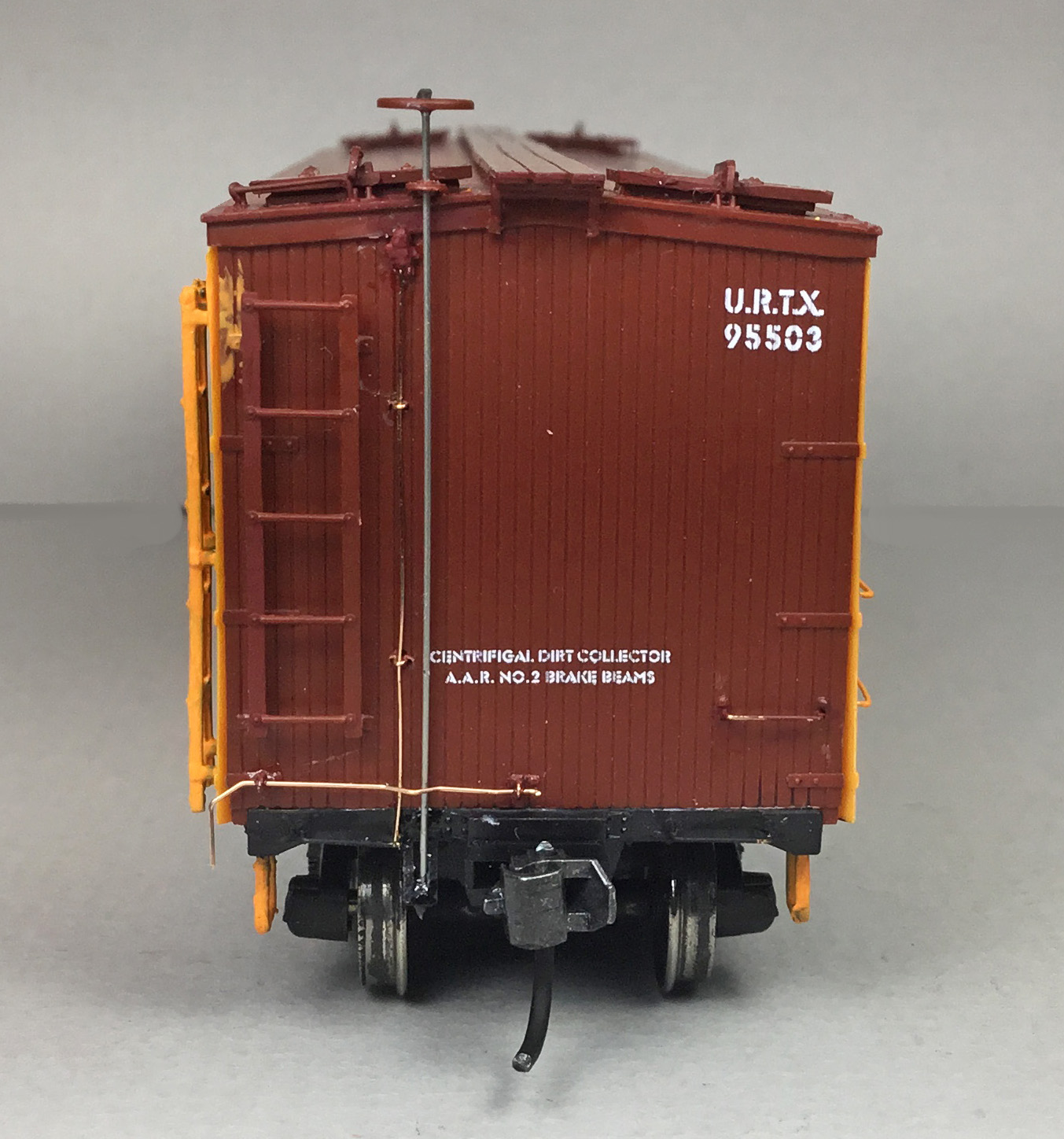

Retainer valve, retainer line and uncoupling lever installed.


Now back to finish the underbody work.  Tichy AB brake components, Tichy set #3013 (not in kit) were installed.  A sill step cut off some plastic car used for a mounting bracket for the air reservoir.  A Sunshine Models resin mounting bracket from the parts box was used for the brake cylinder.  Tichy mounting brackets in set #3013 were used for the control valve.  The remaining underbody added details are the following:

- brake levers were cut from Evergreen strip styrene:
- #8108 1” x 8” for the brake cylinder lever and #8106, 1” x 6” for the floating lever
- piping from air reservoir to control valve, Tichy #1101, .010” diameter PBW
- pipe from brake cylinder to control valve, Tichy #1106, .0125” diameter PBW
- brake rods, Tichy #1106, .0125” diameter PBW
- brake rod clevises, MEK Goop (plastic melted in MEK)
- chain, A-Line black 40 links per inch
- dirt collector, Tichy, #3013-6


Under body details installed.


Refrigerator URTLX 95503 was ready for the paint.  All added parts were hand painted  including the trucks.  I painted some of the parts after install prior to moving on to another build step. The underbody and added parts were painted Vallejo Model Color Black Grey 70.862.  The ends and roof added parts I painted Vallejo Model Color Burnt Red 70.814.  Vallejo Burnt Red is a new color I just found at the local hobby shop.  On the sides I used a mix of 50% Model Color Light Orange 70.911 and 50% Model Color Flat Yellow 70.957.


Underbody with added details hand painted.


All details added were hand painted.


The black and white herald on this model is not correct because it does not have the red in the herald that it should.  Half the black rectangle with “The Peoria Gateway” if divided in half to form two right triangles should have the right triangle on the right red rather than black.  Currently, no decals of the herald size on this car are available.  Therefore, I hand painted the right triangle black portion Vallejo Model Color Flat Red 70.957.

M&St.L herald enlarged from photo
provided by Doug Harding.


Red portion of herald hand painted Vallejo Flat Red.


Once I hand painted the herald,  the carbody was sprayed Vallejo Matt Varnish, 70.520, to protect the car during handling and to provide a weathering base.


URTX 95503 ready for service.


I weathered UTRX 95503 with Pan Pastels as follows:  Paynes Grey Extra Dark 840.1 on roof and lightly on sides and Burnt Sienna Shade 740.3 on sides only.  Pan Pastels were applied with makeup brushes and sponges.  A cotton swab was used to blend applied Pan Pastels on sides.


URTX 95503 weathered with Pan Pastels.


URTX 95503 weathered with Pan Pastels.


After a car card was prepared, URTX refrigerator 95503 was put in service on my Minneapolis & Northland Railroad Company.  It joined the  Union Refrigerator Transit Lines refrigerator car fleet leased to the Milwaukee, Soo Line and the Green Bay & Western on the railroad.


URTX 95503 being loaded at McGregor Co-op Creamery
in Northfield, Minn.


URTX 95503 being loaded at McGregor Co-op Creamery
in Northfield, Minn.


A  “Thank You” to Douglas Harding for photo to help with build of this car and for permission to use in this blog post.  In addition, a “Thank You” to Doug Harding for his help and information regarding correct herald correction.


Thank You for taking time to read my blog.  You can share a comment in the section below if you choose to do so.  Please sign your comment with your name if you choose to leave one.  Please share the blog link with other model railroaders.
Lester Breuer


Monday, June 1, 2020

Milwaukee Road PS-1 Boxcars 35000 and 35044

After building a resin stock car I wanted an easier build.  A review of the kits in the to build cabinet produced two plastic InterMountain Milwaukee Road PS-1 boxcars numbered 35000 and 35044.  The two 1995 limited edition kits were purchased from the the Milwaukee Road Historical Association in 1996.  Therefore, the cars needed to be upgraded with current available parts.  I built MILW 35044 first and followed with the build of MILW 35000.  Each car was built a little different as MILW 35044 used more kit parts than MILW 35000.

The prototype Milwaukee Road (MILW) PS-1 boxcars built in 1951 by Pullman -Standard were assigned to series 35000 to 35044.  The cars had 6 foot Superior doors. The cars were painted and lettered in the MILW original Hiawatha paint scheme used until 1953 when the herald changed to “The Milwaukee Road”.  A very complete article on the the Pullman-Standard PS-1 Boxcar by Todd Sullivan was printed in the December 1982 issue of Mainline Modeler magazine.  The same article appears in the Freight Cars, Volume One (Phoenix Publishing, 1991).  A color photo of MILW 39967 repainted in the 1958 large billboard scheme with large herald on the right can be seen in Milwaukee Road Color Guide to Freight and Passenger Equipment, Vol. 2 (Morning Sun Books, Inc., 2000).


Milwaukee Road 1949 Diagram Book
(click or tap on this or any image to enlarge)


I began the build of cars 35000 and 35044 with the underbody.  On both cars underbody kit parts were used with some exceptions listed below.  Coupler pads and bolster center pads were tapped for 2-56 screws.  Some brake rods broke during flash removal and were replaced with Tichy Train Group (Tichy) phosphor bronze wire (PBW).  Both cars were weighted to 3.8 ounces with eight 1/4 ounce tire weights.  Kadee # 148 whisker couplers were installed in coupler pockets and InterMountain 33” metal wheels in kit ARA cast steel with spring plank trucks with brake shoes removed.


Car tire weights installed in carbody.


Car 35044  used all kit parts with the exception of the following parts:
- bell crank, Tichy, set #3013 (Use kit one.  I could not find kit one.)
- brake rod, Tichy #1106, .0125” diameter phosphor bronze wire (PBW)
- Fastenal 2-56 x 1/4” screws to attach trucks
- Fastenal 2-56 x 1/4” screws to attach kit drilled and tapped coupler pockets


MILW 35044 underbody.


Car 35000 used kit parts except for the following parts:
- couplers pockets, Kadee #262 narrow whisker gearboxes
- styrene coupler pad shim cut from .045” sheet styrene under narrow gearboxes
- coupler pad shim is needed to obtain proper coupler height
- train line, .018” floral wire
- dirt collector, Tichy set #3013
- brake rods, two are Tichy #1106, .0125” diameter PBW
- chain, A-Line #29219, 40 links per inch
- brake cylinder rounded on top with a piece cut from Tichy modern brake cylinder 
- Fastenal 2-56 x 1/4 “ screws to attach trucks
- Athearn , ATH 99003, 2-56 x 5/16” screws to attach coupler pockets and shim


MILW 35000 underbody.


After underbody work was done and weight added, the roof was installed to complete basic body assembly.  Car doors are not added at this time to allow a place to hold the car during remaining assembly.


Basic body assembled.


Ladders were installed next.  Car 35044 received kit ladders and car 35000 had Kadee #2012 ladders installed.  The Kadee ladders required InterMountain drilled holes be filled with plastic rod and new holes drilled with #65, .035” drill for the Kadee ladder mounting pins.


MILW 35044 with kit ladders applied.


MILW 35000 with Kadee ladders installed.


MILW 35000 withe Kadee ladders installed on basic body.


Once I installed the ladders, I moved onto the “B” end details.  Car 35044  and 35000 had the following kit parts installed:  brake gear housing, chain, brake step (platform) brackets, a part of plastic brake rod  and brake rod clevis to attach to bell crank and placard boards. Other detail parts used on the car follow for each car.

MILW 35044 “B” end parts installed:
- brake step, Plano Model Products set #11322
- brake rod, Tichy #1102, .015” diameter PBW ( between chain & brake rod clevis)
- retainer valve, resin part with plastic made parts added to match prototype
 - use kit retainer valve (My kit retainer valve flew away from tweezers)
- retainer line and brackets, Tichy #1100, .008” diameter PBW
- brake wheel, kit ( need to change to Kadee Universal)
- Kadee PS-1 end grab irons, end grab fits existing holes, sill grab new holes drilled
- eye bolts for uncoupling lever formed from Tichy #1101, .010” diameter PBW
- uncoupling levers, bent from Tichy, #1106, .0125” diameter PBW


MILW "B" end with some detail parts added
before being hand painted.


MILW 35044 "B" end with details applied.
Some details have already been painted.


Retainer valve rework.  Bits box plastic rod with
portion of Kadee ladder rung for handle.

MILW 35000 “B” end parts installed
- brake step, made by cutting out of a Kadee Apex lateral running board
- brake rod, Tichy #1102, .015” diameter PBW
- retainer valve, kit
- retainer line and brackets, Tichy #1100, .008” diameter PBW
- brake wheel, Kadee Universal #2023
- Kadee # 2250 and # 2253, PS-1 end grab irons, end grab fits existing holes
- Kadee sill grab iron requires new holes drilled for install
- eye bolts for uncoupling lever formed from Tichy #1101, .010” diameter PBW
- uncoupling levers, bent from Tichy, #1106, .0125” diameter PBW


MILW 35000 "B" end details.


MILW 35000 "B" end with made brake step (platform)
 visible from above.


Next the roof.  A Kadee Apex #2001, hand painted with Vallejo Model Air aluminum 71.062, prior to install, was installed.  The mounting pins on end brackets need to be cut off to mount flush on the car body end.  The running boards were installed at the end of a modeling session using Formula 560 Canopy glue and a weight added allowing the glue to dry overnight.


MILW 35044 with Kadee Apex running boards applied.


MILW 35000 with Kadee Apex running boards applied.


I only needed to do the work on the sides to complete the builds.  Kadee #2251 grab irons were installed.  The Kadee #2251, bracket grab irons mount in the kit holes that InterMountain made.  A-Line sill steps #29000, style A, under the grab irons on the left side and # 29002, style C , under the ladders were installed in holes made with #76 drill.  The doors were installed.  Prior to install molded on door handles were carved off and replacements made with Tichy #1101, .010” diameter PBW.  And, placard boards provided in the kit were installed.


MILW 35044 with side details.
Door placard boards yet to be added.


MILW 35000 with side details installed.
Door placard boards have been added.


With all detail parts added to complete build and upgrade, parts were now hand painted.  On the sides Vallejo/Micro-Mark Model Air 71.080, Boxcar Red was used.  On the ends and underbody I used Vallejo Model Color 70.950, Black.  And, the trucks were hand painted with Vallejo Model Color 70.862 Black Grey. When all detail parts were dry the car body was sprayed with Vallejo Matt Varnish 70.520 , to protect cars during handling and to provide a weathering base.

I used Pan Pastels and Artmatic eye shadow makeup to weather both cars.  Pan Pastels used were as follows: Payne’s Grey Extra Dark 840.1  on roof and  very light on car body, Burnt Sienna Shade 740.3  on side and on ends and Artmatic eye shadow makeup lightly on the side and ends.  Weathering applied with makeup brushes, sponge applicators and Q-tips for blending and final finishing.

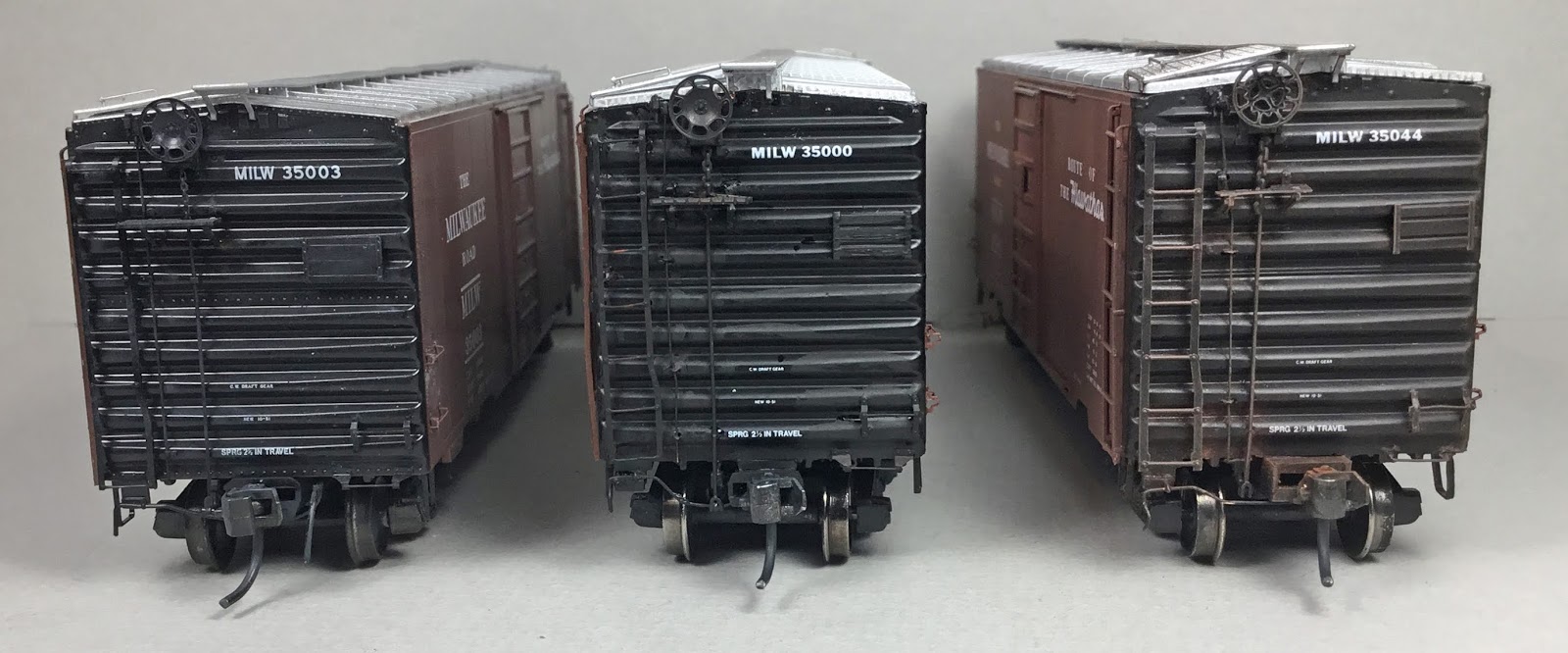
Since Kadee set the high standard for the PS-1 boxcar reviewed in Railway Prototype Cyclopedia, RP CYC 2 ( RP CYC Publishing Company, 1998),  I thought I would include several comparison photos.


Kadee  MILW 35003 on left.
 InterMountain MILW 35044 upgraded on right.


Kadee  MILW 35003 on left'
 InterMountain  MILW 35000 upgraded on right.


Kadee MILW 35003 on left.
InterMountain MILW 35000 center and MILW k35044 on right.


After weathering with Pan Pastels MILW 35000 and MILW 35044  were ready for service on the Minneapolis & Northland Railroad Company, “Serving today, Shaping tomorrow.”  The Minneapolis & Northland Railroad Company fleet has increased two more cars.  Two cars that should have been in service years ago.


MILW Road PS-1's sitting on mainline before
being moved into Minneapolis Chestnut Street yard.


MILW Road PS-1's sitting on mainline before
being moved into Minneapolis Chestnut Street yard.


Thank You for taking time to read my blog.  You can share a comment in the section below if you choose to do so.  Please sign your comment with your name if you choose to leave one.  Please share the blog link with other model railroaders.
Lester Breuer


Saturday, May 16, 2020

Rock Island Stock Car 75050

After review of the resin kits in the to build cabinet I chose Rocket Express Models Chicago, Rock Island & Pacific (RI) stock car, kit RI-6.1.  The stock car received number 75050 based on decals.  Rock Island stock car 75050 would be the first Rock Island stock car in service on my Minneapolis & Northland Railroad Company Railroad.

The prototype stock cars built in 1950 by the Ryan Car Company, series 75000 to 75249 were the last new stock cars built new for the Rock Island.  The stock cars were Howe truss design with wood sides and ends and a door one each end.   The cars had a Murphy mullion roof with wood running boards.  A color photo of 75010 can be viewed in the Rock Island Color Guide to Freight and Passenger Equipment ( Morning Sun Books Inc., 1996).

Phil Weibler collection.  Courtesy of Steve Hile
(Click or tap on this or any photo to enlarge.}


Phil Weibler collection.  Courtesy of Steve Hile


As with all resin kits the first step in the build is to remove flash.   A stock car takes a good deal of time to accomplish this task due to removal of the flash between boards on sides.  I follow the recommended procedure for this task by sanding the back of the sides and doors on a piece of 100 grit sandpaper lying on a flat work surface thinning the parts until the flash begins to disappear.  At this point I will use a scalpel to remove the remaining flash between each board.  After finishing with the scalpel I go back with a sanding stick with a point shaped like that on a sharpened pencil to sand between each board.   It is the removal of flash between boards that makes a stock car a unique build.

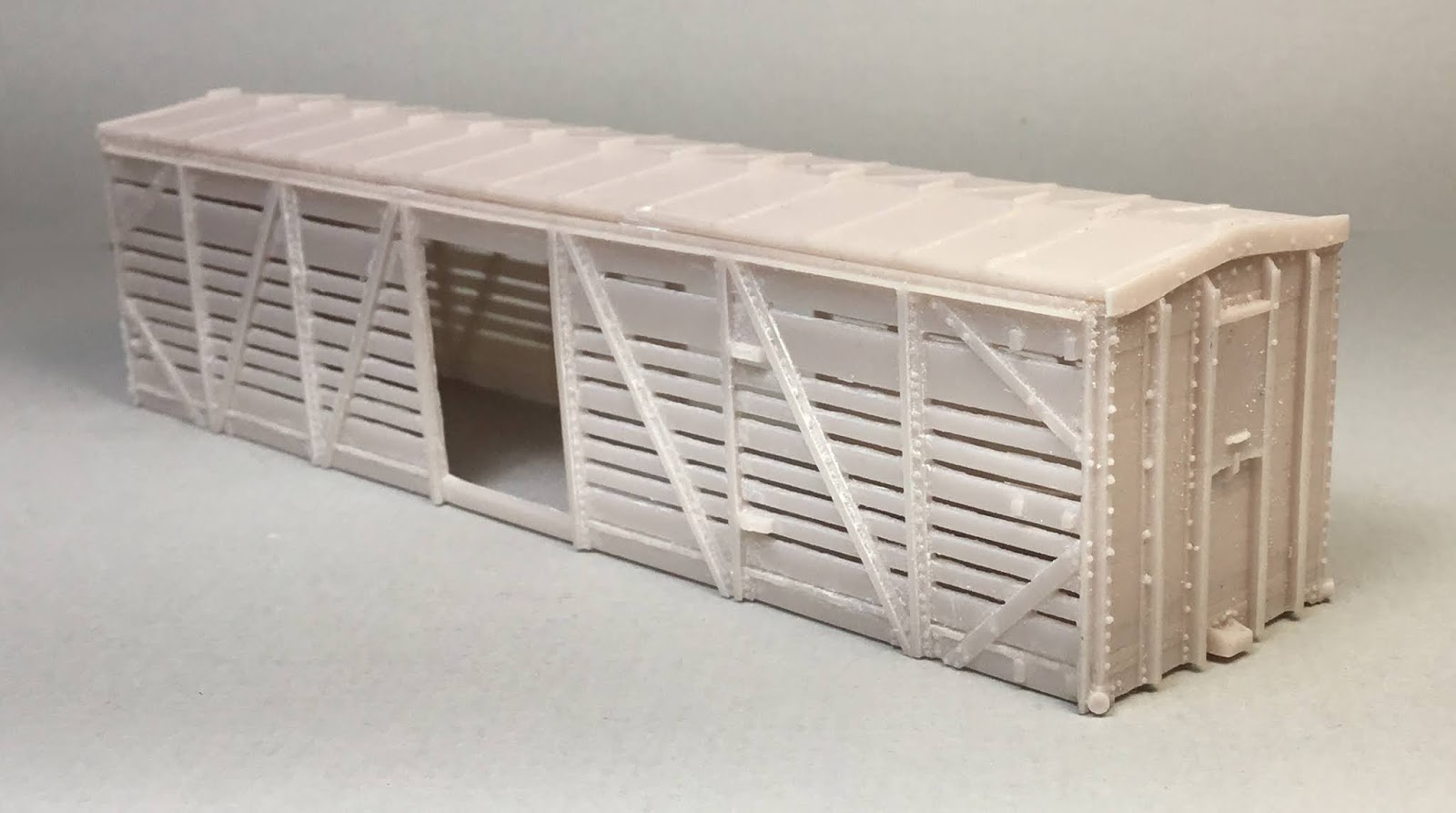
With the flash was removed, I began the build of this flat kit with the assembly of the “ basic box” consisting of sides and ends.  Normally I would install corner reinforcements and add a baffle; however, I did not do this on stock car for you can see into the car between the boards.  Next the roof was installed to complete the exterior car body; however, it required the tip of the ends be sanded to the shape of the rabbit in the roof to get a proper fit. A resin fascia piece is glued over the end of the installed roof.


Basic box with roof and fascia installed.


I fitted the underbody which required removal of material beyond coupler pockets on both ends to accomplish.  I installed cross bearers, cover plates and bolster plates.


Cross bearers, cover plates and bolster plates installed.


I drilled and tapped the coupler pocket pads and bolster center plates for 2-56 screws.  Kadee #262 narrow whisker gearboxes with Kadee #148 couplers were installed with Fastenal 2-56 x 3/16” screws.   Tahoe Model Works, TMW 106, Buckeye ARA 50 ton trucks included in the kit were installed with Fastenal 2-56 x 1/4” screws.  Car was weighted to 3.8 ounces with eight 1/4 ounce tire weights.


Couplers and trucks installed.


Car weighted to 3.8 ounces with tire weights.


At this point in the build I did not follow the kit instructions to mount a brass bar that needed to be cut in half and a half glued  on each side of the interior carbody in a location determined using math calculations to create a underbody mounting support.  Instead, the under body was inserted into the car body with the coupler pockets extending over the ends to support it to determine the proper depth.  A pencil was used to draw a line in the interior of the car body above the floor via the door opening .   The underbody was removed and a Evergreen #8208, 2” x 8” styrene strip cut to the inside length of the car body, was glued above the line to act as a underbody support when installed.  The underbody was now installed.


Line drawn for styrene floor support install.


Styrene underbody support installed.


Car body with underbody installed ready for detailing.


With underbody installed, detailing of the car body begins.  I drilled the holes with a #79 drill for end ladders consisting cast on stiles and drop grab irons for rungs, and all side and end grab irons.  I installed all grab irons on sides and ends and the grab irons for ladder rungs on the ends.


All grab irons installed.


On the “B” end the resin brake shaft mount (in photo on fascia) and resin brake shaft step were installed.  A Precision Scale #31796, retainer valve (not in kit) followed by a retainer line and brackets, Tichy Train Group (Tichy) #1100, .008” phosphor bronze wire (PBW) were installed.  Resin cast door handles were carved off and handles bent from Tichy #1101, .010” diameter PBW were installed.   


Brake shaft brackets, retainer valve and line installed.


On the sides I did not use the kit ladders you have to build with resin stiles and grab irons.  Kadee ladders, #2102, which matched the spacing of the end ladder were cut down to six rung ladders and installed.  In addition, I installed the upper resin and lower wire door guides using photos and instructions.


Side ladders and door guides installed.


On to the under body.  I installed the Tichy brake components provided in the kit.  I used a Sunshine Models brake cylinder bracket from the parts box to mount the brake cylinder and a plastic sill step cut from some plastic car for the air reservoir bracket near the crossbearer.  Brake lever hangers provided in kit were installed next.  Brake levers I made from Evergreen #8108, 1” x 8” and #8106, 1” x 6” strip styrene were installed.  The slack adjuster for the floating lever was made with a piece of styrene angle from the bits box with holes drilled in it with a #80 drill bit.


Brake components installed.


I continued on the underbody installing the following details:
- piping from air reservoir to control valve, Tichy #1101, .010” diameter phosphor bronze wire (PBW)
- pipe from brake cylinder to control valve, Tichy #1106, .0125” diameter PBW
- brake rods, Tichy #1106, .0125” diameter PBW
- chain attached to brake rod and brake cylinder lever was provided in kit
- clevises for brake rods made with MEK Goop
 - train line, .018" flora wire (not in kit)
 - dirt collector, Tichy, set #3013


Underbody details added.


Onto the roof details.   The longitudinal laser cut running board was installed with Formula 560 canopy glue and weight added at the end of a modeling session to allow it to dry overnight.  The next day the kit provided photo etched end brackets were installed on the ends.  Prior to install,  mounting brackets for latitudinal running boards cut from .005” x .040” photo etched brass were glued to running boards with Formula 560 canopy glue with extensions on rear for gluing to the longitudinal running board and on front for forming round roof mount section on the front.  I would have used the .010” x .030” brass flat bar in the kit for this purpose; however, I could not find it at the time.  Once the glue was dry the latitudinal running board brackets were bent to shape on the ends and installed. Roof wire grab irons provided in the kit were installed with Yarmouth Model Works photo etched eye bolts without shoulder (not in kit) for corner legs.


Running boards installed.


Sill steps were now installed.  A-Line #29000, style A, sill steps were installed rather then the kit provide plastic sill steps.  The mounting holes were drilled with a #76 drill in the sill.  The sill mounting brackets were cut from .005” x .040” metal foil in which rivets were made with RB Productions RB-T009 Rivet-R riveting tool.


Sill steps installed.


Back to the “B” end.  Uncoupling lever brackets consisting of a resin back plate and eye bolt were installed.  The resin back plates were glued to the sill.  After the glue was set, a #80 drill was used to drill a hole in the back plate and an eye bolt provided in kit was installed to complete the uncoupling lever bracket.  Uncoupling levers provided in the kit were installed.


Uncoupling lever bracket, uncoupling lever and
 note brake shaft bracket.


The brake shaft, Tichy #1102, .015” diameter PBW was installed.  Prior to install, a small resin gear form my parts box was installed onto brake shaft to sit above fascia mount as on prototype.  The kit provided Tichy brake wheel was installed.  A small disk was added to the center to match the prototype. A mounting bracket below the end door (see photo above for closer view) was made made with .005” metal foil.  The vertical brake shaft was not added until now due to its height which is about the same distance as that between the end drop grab iron ladders rungs.


"B" ends details completed.


Back to sides to install the doors.  I do not install doors until the end of the build as the area under  doors prior to install provides an area to hold the car during various stages of the build.


Doors installed.


Car is ready to prep for paint.  I washed the car body and underbody with a cotton makeup swab dipped in 91% alcohol.   Now the paint.


Stock car is ready for paint and lettering.


 The underbody was sprayed Vallejo Model Air 71.055, Black Grey RLM 66.   The car body was sprayed mineral red mixed with Vallejo Model Color: Black Red 70.859, 75% and Flat Yellow 70.953, 25%, thinned 50% with a custom mix of distilled water, Vallejo air brush thinner #71.161 and Vallejo Airbrush Flow Improver 71.562.  If  a lighter mineral red is mix desired use 50% black red and 50% flat yellow.


Stock car painted.


Stock car underbody painted.


Immediately, after spraying back to the workbench to begin running board weathering.   I used a cotton makeup swab dipped in 91% isopropyl alcohol and removed some of the paint from the laser cut running boards to expose the wood.  This was the first time I had thought to use this weathering method with a laser cut running boards.  I liked the result and will add it to my weathering methods.


Paint removed from running boards.


After paint dried overnight, I added the hand painted control valve protective shield  cut from resin flash.  If the shield had been added earlier the control valve would have been difficult to paint.  Now, the car body was sprayed Vallejo Gloss Medium #70.470, for decal base.


Shield to protect control valve added.


I lettered the stock car with decals provided in the kit. The decals were applied with MicroScale Micro Set and Micro Sol.  The reporting marks and number due to printed size had to be located on board above bottom board as in prototype photo.  Some Rock Island stock car photos have the reporting marks and number in this location.  Due to reporting marks and number location the data decals had to be adjusted accordingly.   When decals were dry, the car body was sprayed with Vallejo Matt Varnish 70.580, to protect dry transfers and decals during handling and for weathering.


Rock Island stock car 75050 lettered.


Rock Island stock car 75050 end lettering.


Rock Island stock car 75050 lettered.


Rock Island stock car 75050 built in 1930  would be showing a weathered look running in spring of 1955.  Therefore, I applied weathering to the car using the following Pan Pastels:  Paynes Grey Extra Dark 840.1 on the roof, Netural Grey Extra Dark 820.2 on the sides, Paynes Grey Tint 840.7 in spots over the Netural Grey Extra Dark to provide a lighter aging and Red Iron Oxide Extra Dark 380.1 for fading the lettering.  I used the photo in Rock Island Color Guide to Freight and Passenger Equipment book as a guide for my weathering.


Side view of weathered RI stock car 75050


Another view of the weathering applied.


Roof view after weathering.


After painting and lettering was completed the car could enter service on the Minneapolis & Northland Railroad Company after a car card was made.  Rock Island stock car 75050 will be delivering cattle to Swift located in Northfield, Minnesota on the Minneapolis & Northland Railroad Company.


Swift in Northfield, MN


RI 75050 will get spotted at the cattle
pens as these stock cars when delivering
cattle to Swift.


A  big “Thank You” to Steve Hile for the photos to help with build of this car and for permission to use photos in this blog post.  And, another  “Thank You” to Steve Hile for his help and information regarding correct placement of brake detail.


Thank You for taking time to read my blog.  You can share a comment in the section below if you choose to do so.  Please share the blog link with other model railroaders.
Lester Breuer