Friday, November 15, 2019

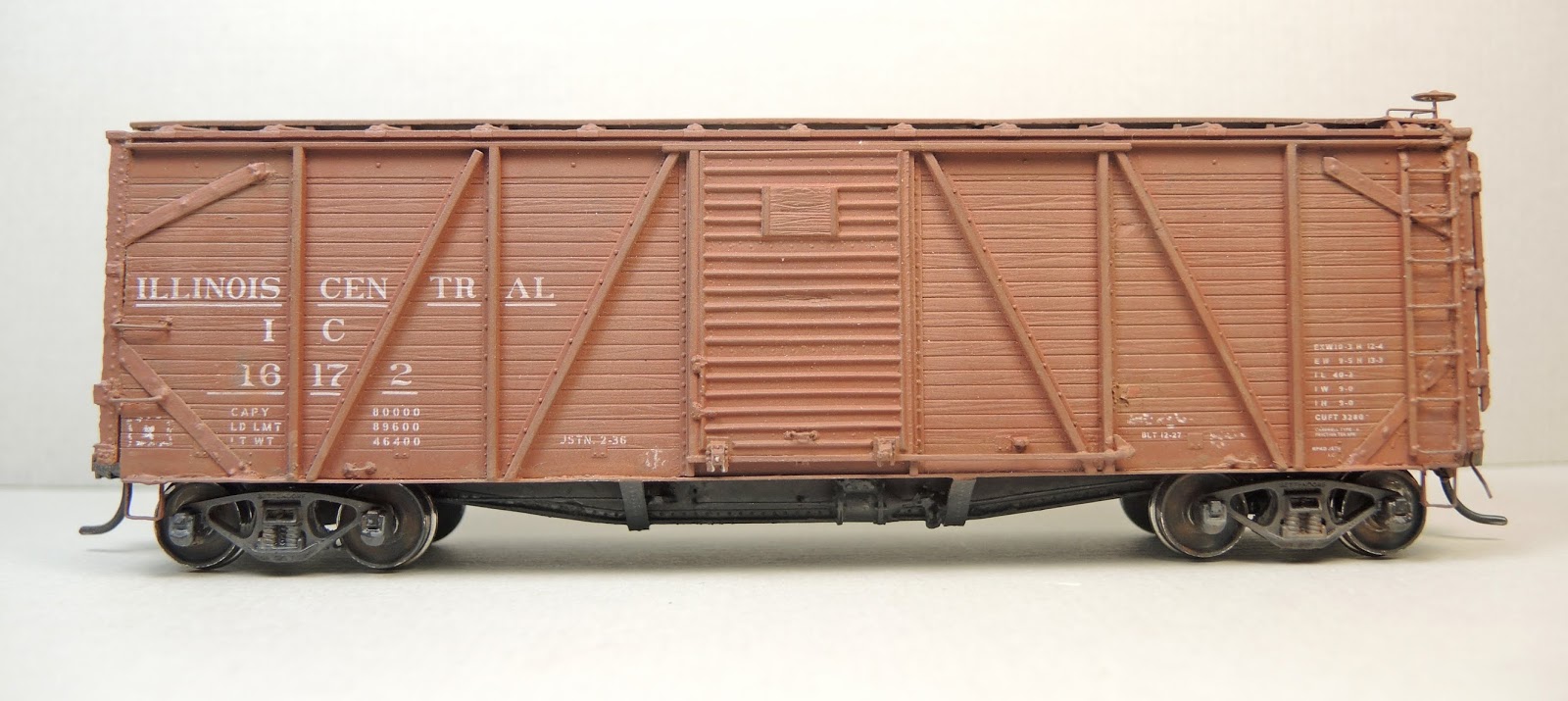
Illinois Cental SS Boxcar 16172

I was one of the Chicagoland RPM attendees to receive the mini-kit containing resin parts and decals to build an Illinois Central single sheathed boxcar with unusual 3/5 dreadnaught ends.  After arriving home from Chicagoland RPM I went to the Accurail website and ordered two Illinois Central, IC, number 7116 kits.
Chicagoland RPM Mini-kit
(Click or tap on this or any photo to enlarge)


The prototype car I chose to model was one of 500 cars built by Mt. Vernon Car Company in 1927 assigned to the number series 176000-17699.  Another 500 cars built by Pullman Car & Manufacturing were assigned to the same series.   In the 1940’s the cars were renumbered into the 16000-16975 series.  The cars were single sheathed with a Hutchins Dry Lading  roof, Youngstown steel doors, unusual 3/5 dreadnaught ends, angled side sills and a fishbelly center sill underframe.  Photos of cars in the series can be found in the Chicagoland Program or Steam Era Freight Cars Reference Manual. Vol.1: Box and Automobile  Cars (Speedwitch Media, 2006, 2007).
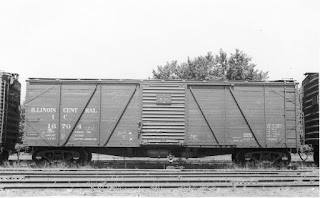


Ray Breyer Photo Collection


Ray Breyer Photo Collection


The kits arrived in a few days allowing the build of car 176172 ( car number on car in kit) to begin.  Instructions for the build can be found in the Chicagoland Program which I read and used; however, deviated from at times.  I started by cutting off the molded on sill steps on the car body.  Next I  removed the running boards, cut off the mounting pins and installed them back into the roof holes.  Once the glue is dry,  the pins are squeezed with a square jaw pliers, cut and sanded to height to form a roof saddle.  I followed the roof preparation by cutting off the ends of the Accurail boxcar with an UMM saw available from UMM-USA or Micro-Mark.  I marked the roof cutting line with a flex rule and pencil.


Flex rule used to mark roof for cutting.


Cutting roof  with UMM saw to remove end.


Once the ends were cut off I cut and installed a false end cut from Evergreen .060” sheet styrene.  I also cut and installed a baffle  cut from Evergreen .060” sheet styrene at this time.


False ends and baffle installed.


Now I inserted the underframe and used the coupler pockets, as a guide to install the ends.  On the ends the notches for the couplers pockets were placed over the floor coupler pockets for easy alignment.  If you use this method be careful not to apply glue below the false end so as not to glue the floor to the resin ends being installed.  After the top section glue dried, I removed the floor and added the glue to the lower section from the inside.


Coupler pocket used as aid to attach 3/5 resin ends.


Next, all molded on grab irons on sides, ends and running boards were carved off followed by the molded on door handles.  Since I thought the molded on ladders were a good match to the prototype I kept the stiles and carved off the ladder rungs.  I did have the Plano Model Products #12121 photo etched ladders that require stile bending suggested in the instruction sheet; however, I chose not to use them.  The corner braces on the sides were applied next.  I used two kit provided braces (.012” thick) after sanding to make them thinner for the top; however, for the bottom braces I cut two from the parts  .006” flash so no thinning needed.  The corner brace fasteners were made with MEK Goop ( plastic melted in MEK).  Back to working on the removed running boards.  The running boards were milled and scraped with a single edged razor blade to a .025” thickness and installed.  You could purchase or  scratch build  new running boards.


Corner braces and running boards installed.


Side corner braces and reworked running boards installed.


After installing corner braces, grab irons bent from Tichy Train Group (Tichy) #1101, .010” diameter phosphor bronze wire (PBW) were installed on sides ends and ends. And, ladder rungs bent from the same PBW were installed on the sides.  Again, the Tichy #1101 .010” diameter PBW was used to bend a door handle with a Xuron wire bending pliers.  Only one door handle is needed as the prototype had only one and not two as came molded on the doors.  Two tow loops were bent from Tichy #1101 .010” diameter PBW and installed. The fasteners for the tow loops were made with MEK Goop.  Another detail needed to complete the car side work was the install of the lower door track cut from Evergreen #8203, 2" x 3” strip styrene .022’ x .033” which is slightly larger than the .020” x .030” specified in the instructions. A door stop, a small triangle on the end of the track in some photos,  was cut from .005” styrene and installed resulting in the removal of the molded on door stops on the sides.  I installed A-Line, #29000, style A, sill steps to complete the sides.   I would recommend adding the Evergreen #8106, 1” x 6” strip styrene for the side flange to the side sill prior to installing the A-Line sill steps and not as I did waiting until finishing the under body work making the install at that time  harder as it required cutting sections of the sill flange to fit around the sill steps.

Side details have been added.


After finishing side details I completed the roof work.  The longitudinal running board end braces cut from Evergreen, #8102, 1” x 2” were installed and fasteners were made with MEK Goop.   I made a mounting bracket for the latitudinal running board from Evergreen #8012 1” x 2” shown in this photo that cracked.  Not happy with the result I removed this bracket and made another cut from photo etched scrap brass and installed it.

Roof after details added.

B" end showing roof and
 longitudinal running board braces and
MEK fasteners.


I worked on the “B” end next.  To match the side ladders I installed  Grandt Line Freight Car ladders, #5124 I had in my parts inventory.  To match the ladder mounts cast on the end casting for the ladders on the left side , the ladder mounts on the right side were cut from Plastruct #90501, 3/64” styrene angle and glued with angle toward the ladder style.  The ladder rung spacing is a close match to those on the side ladders; however, to get a better match I cut off the ladder rungs leaving the styles and installed new ladder rungs cut from Plastruct #90850, .010” diameter styrene round rod.   A Tichy brake step (platform) and brackets from set #3013 were installed.  The retainer valve is a resin one provided in the mini-kit.  A retainer line, Tichy  #1100 .008” diameter PBW followed the retainer valve install.   A brake shaft step, an A-Line #29000 sill step, was installed. The brake shaft  is Tichy #1102, .015” PBW with a Tichy brake wheel from set #3013. The brake shaft bracket is Tichy #1101 wire formed in a “U”, installed, and squeezed with a needle nose plier and filled with gap filling CA to create the bracket.  Placard boards provided in the mini-kit were installed here and on the “A” end.  Finally, Carmer uncoupling levers, Yarmouth Model Works (YMW) # 400 photo etched levers were installed.  A #80 hole was drilled in the end casting mount, a post cast on the end sill for that purpose and a short Tichy #1101 .010” PBW was glued in.   Now the YMW levers using the holes in them were placed on the wire pin and CA applied. When the CA set the wire pin was cut off next to the added levers.


"B" end details installed.


I only had under body work to complete.  Accurail Fish belly center sill was installed.  Accurail coupler pockets and covers were used rather than cutting them off and installing the mini-kit resin cast coupler pockets.  Truck bolster cover plates and coupler pockets were tapped for 2-56 screws.  Molded on cross bearers were cut off and resin cross bearers and cover plates provided in mini-kit were installed.  Mini-kit resin brake components drilled for piping were installed.  The brake cylinder was mounted in the normal location.  Photos show the air reservoir  centered under the door and control valve next to it on the other side of the fishbelly center sill.   Other under body details installed were as follows:

  • Brake Levers, Evergreen #8108 1” x 8” and #8106 1” x 6” strip styrene
  • Pipping from air reservoir to control valve, Tichy #1101 .010” PBW
  • Piping from brake cylinder to control valve, Tichy #1106, .0125” diameter PBW
  • Brake rods, Tichy #1106 .0125” PBW
  • Chain, A-Line black #29219, 40 links per inch
  • Train line, .018” floral wire
  • Dirt collector, Tichy, set #3013
  • Train line couplings and dirt collector tee, MEK Goop
  • Side flange, Evergreen #8106, 1” x 6” strip styrene

Under body details installed.


With the under body work complete the car was moved to the paint shop.  The under body was hand painted with Vallejo Black Grey 70.862.   The detail parts and car ends on the car body were painted with a Vallejo mix:  Model Color Black Red, 70.859, 2 drops or 50% and Model Color Saddle Brown, 70.940, 2 drops or 50%.   At times the paint or paint mix to match a manufacture's paint used can be difficult to find.   Such was the case with this Accurail applied paint.

The car number was changed from 176172 to 16172.   The 1 and 7 in the original car number were removed with a Euro scratch brush and Woodland Scenics R.R. Roman Numbers-White, dry transfer lettering, set DT510, was used to add the 1.  On the ends, the area above the top rib was brushed with Vallejo Gloss Medium 70.470.  When dry, decals I made were applied.  The decals were made with Clover House Railroad Roman Alphabet Condensed Bold White #9600-11 dry transfers applied to decal paper and coated with Microscale Liquid Decal Film.  The decals were applied with Microscale Micro Sol.  When decals were dry, the car body was sprayed with Vallejo Matt Varnish 70.520 to protect dry transfers and decals during handling and for weathering.


Number has changed to 16172 and car body was sprayed
with Vallejo Matt Varnish.


Ends painted and end number decals applied.


Under body after painting.


Illinois Central boxcar 16172 was weathered with Artmatic eye-shadow makeup and Pan Pastels.  The eye-shadow makeup, a brown color similar to the boxcar color, was applied to the sides and roof.  Pan Pastels used were as follows:  Paynes Grey Ex. Dark 840.1, was applied to the roof and lightly to the sides, Neutral Grey 820.5 and Red Iron Oxide 380.3 were applied over the new lettering to tone it down.

Car weathered with eye-shadow makeup and Pan Pastels.

After weathering Illinois Central boxcar 16172 was put into service on the Minneapolis & Northland Railroad Company.


IC boxcar 16172 at Sussex lumber yard.


Better side view of IC boxcar 16172 at Brook's Lumber in Sussex.


"B" end view of IC boxcar 16172 at Brooks Lumber in Sussex.


I want to say, "Thank You" to Ray Breyer for providing prototype photos and permission to use the photos from his collection on this blog.


Thank You for taking time to read my blog.  You can share a comment in the section below if you choose to do so.  Please share the blog link with other model railroaders.
Lester Breuer


Friday, November 1, 2019

Private Name Freight Cars for Exchange

Another home road Minneapolis & Northland Railroad Company boxcar completed in the M&N Car Shops will be going into service on another railroad.   This time the car will be going to the Central Of Minnesota Railroad.  Why?  The boxcar was built to complete an exchange of cars.  Earlier this year for a visiting group operating session, Joe Binish brought and left one of his Central Of Minnesota home road cars to continue in service on my Railroad.

Central Of Minnesota built by Joe Binish
(click or tap on this or any photo to enlarge)


Central Of Minnesota built by Joe Binish

I did not have a freight car to give Joe in exchange at the time.  Finally, I found the car kit I wanted to build for exchange and shop schedule was right to build the car to reciprocate.


Upgraded Minneapolis & Northland Railroad Company 469245 boxcar.


The Minneapolis & Northland Railroad Company boxcar was upgraded for the move to Joe Binish’s Central Of Minnesota railroad.  An Accurail kit, number 4008, lettered for the Grand Trunk Western, a single sheathed boxcar with four post ends and Hutchins roof had the following changes made.

Molded on side and end grab irons were carved off and replaced with Tichy Train Group (Tichy) straight grab irons # 3021.  Molded on roof grab irons were carved off and grab irons bent from Tichy #1101, .010” diameter phosphor bronze wire (PBW) with Yarmouth Model Works eyebolts without shoulder were used for corner legs.  Molded on sill steps cut off were replaced with A-Line #29000, style A, sill steps. Molded on door handles were carved off and replaced with wire door handles, Tichy #1101, .010” diameter PBW, bent with Xuron wire bending plier.

Side details added.


On the “B” end a Sunshine Models resin retainer valve from the parts box was installed followed by a retainer line and brackets, Tichy # 1100, .008” diameter PBW.  The brake step was opened by drilling out the molded interior with a 2-56 drill and cleaned up with broach (see “broach” under “labels” on sidebar) and small diamond file.   A brake rod, Tichy #1102, .015” PBW with Tichy .010” wire bracket, was installed onto which a Tichy brake wheel, set #3010, was installed.  A top mount uncoupling lever bent from Tichy #1106. .0125” diameter PBW with eye bolt brackets bent from Tichy #1101 .010” was installed and another on the “A” end.  The longitudinal running board brackets cut from Evergreen, #8102, 1 x 2” strip styrene were added here and to the “A” end.


"B" end details added.


On the under body bolster center plate and coupler pockets were drilled and tapped for 2-56 screws.  Kadee #148 couplers were installed in coupler boxes using Fastenal 3/16” screws to attach coupler pocket covers and Fastenal 1/4” screws to mount Accurail ARA cast steel with spring plank kit trucks.  Kit brake components were installed after drilling them with #79 wire drill to receive piping.  Piping from air reservoir to control valve, Tichy #1101, .010” diameter PBW and from brake cylinder to control valve, Tichy # 1106, .0125” diameter PBW.  Brake Levers made from Evergreen #8108 1x8” and #8106” 1x6” strip styrene were installed.  Brake rods, Tichy, # 1106. .0125” diameter PBW were installed. Chain to brake rod from brake cylinder piston is A-Line black 40 links per inch.


Under body details.


In the M&N paint shops the Grand Trunk Western herald and GTW reporting marks were removed with a Euro scratch brush and a cotton swab dipped in 91% isopropyl alcohol.  The areas where  lettering was removed and added car body details were hand painted with a mix of Vallejo Model Air Brown RLM  26, #71.105, four drops and a tiny drop using a wood round toothpick tip dipped in Vallejo Model Color Black Grey, 70.862, to create a paint shade matching the Accurail factory applied paint.  The under body was hand painted with Vallejo Model Color 70.862, Black Grey.   When dry the car body was sprayed with Vallejo 70.470, Clear Gloss Medium to provide surface for decal application.  Once dry Private Name Champ Decals, Alps printed herald, and end reporting marks decals made by applying Clover House Railroad Roman condensed Bold-White dry transfers to decal paper coated with MicroScale Liquid Decal Film were applied with MicroScale Micro Sol and Walthers Solvaset.  After letting dry overnight the car body was sprayed with Vallejo 70.520, Matt Varnish to protect lettering and provide a surface for weathering.


Car is painted and lettered; however, not weathered.

Weathering was done with Pan Pastels applied with foam pads and makeup brushes.  Pan Pastels colors used were: Burnt Sienna Shade 740.1 on sides and roof, Paynes Grey Ex. Dark 840.1 on roof and lightly on sides, and Red Iron Oxide Ex. Dark 380.1 to fade lettering on the car body.  No clear coat applied after weathering.


Car body weathered with Pan Pastels.


M&N boxcar 465249 sitting on CNW Interchange track to be
picked up and delivered to the Central Of Minnesota railroad.


The Minneapolis & Northland Railroad boxcar was delivered to the Central Of Minnesota for serving  their customers.  Do all cars exchange have to be upgraded?  The answer, “ Of course not.”  I have exchange cars that are build per kit instructions with no upgrades. 

Why exchange and run Private Name cars?  Each time I take a Private Name car out of it's box to enter my railroad via an interchange it brings memories of the person and his or her railroad.   I want to share photos of some of these Private Name cars with you here of railroads still operating and railroads that no longer exist due to the passing of owner.


Dave Vos,  operating railroad.


Ken Herman, railroad of deceased friend.


Gerry Leone, railroad dismantled for move to new home.

Mike Rhein, deceased friend.

Bob Johnson, owner.


Michael Jordan,  Santa Maria Valley Industrial
operating railroad.


Gary Gelzer,  railroad of deceased friend.


Erine Schwenke, test railroad.


Larry Brandsetter, owner.


Thank You for taking time to read my blog.  You can share a comment in the section below if you choose to do so.  Please share the blog link with other model railroaders.
Lester Breuer


Tuesday, October 15, 2019

Northern Pacific Hopper 70168

While setting up for an operating session, I pulled Northern Pacific hopper 70168, Train-Miniature (TM), kit 2964, out of storage to haul a load of coal from the Great Northern Interchange track to J. D. Owen Coal in Little Chicago.   As I placed it on the on the GN Interchange track I thought it was time to upgrade the hopper I had acquired from a friend who passed a year ago.  The  level of upgrade would depend on if a prototype existed.

I found the hopper was close in dimensions to NP prototype, class HM series series 70050-70199 built by Pressed Steel Company in 1932.  A hopper car diagram with dimensions is available from the Northern Pacific Railway Historical Society.  Based on photos many details such as the number of gussets on offset side, rivet patterns and brake gear end need to upgraded.   A photo of 70162 with lettering style like TM hopper 70168 is in the NP Color Guide to Freight and Passenger Equipment ( Morning Sun Books Inc., 1995). A photo of 70065 with earlier lettering style is in Train Shed Cyclopedia, No. 5, Gondolas and Hoppers from the 1940 Car Builders’ Cyclopedia (Newton K. Gregg/Publisher, 1973) or 1940 Car Builders Cyclopedia, Fifteen Edition (Simmons-Boardman Publishing Company, 1940).

NP Historical Society diagram
Click or tap on this or any photo to enlarge.


Bob's Photos Courtesy of Gary Wildung


I began the upgrade on the sides by carefully carving off the gussets on the offset sides except for the end and middle gussets.  Careful removal of the three gussets between the end and middle gussets is necessary as two of the removed gussets need to be reused to correctly position two gussets, the first 4 ft. 6 in. from the end gusset and the one nearer the middle again 4 ft. 6 in. toward the middle gusset.  The proper positioning of gussets results in 7 gussets , each 4 ft. 6 in. from the next.  After, the gussets were set I used Evergreen 1 x 4 in. strip styrene to make the triangle portion of the gussets.   The 1 x 4 in. strip styrene was cut the length of the a gusset using a Northwest Shortline Chopper as 14 pieces are needed.  The rectangular pieces are glued to the gussets and after glue is dry trimmed to the triangle shape using a sprue nipper. 


NP hopper 70168 prior to upgrade.


Gussets have been installed in new location.


Triangle pieces added to gussets  to complete gussets.


The  rivet rows that were under the removed gussets were carved off next.   Next the molded on sill steps were cut off.  New side sill Tichy Train Group (Tichy) #3043, double step side sill steps were installed  in holes drilled in the bottom of the side sill with a #76 drill.  However, the sill steps are not complete as they also have a end sill mounting leg.  The sill step portion located on the end sill was made by inserting and gluing Tichy #1106, .0125” diameter phosphor bronze wire (PBW) into a #79 drilled hole.  Once glue was set, the wire was bent toward the side double sill step at a 45 degree angle and cut off where it was touching the  side mounted double mounted sill step.  Glued was applied to the joint completing the double step sill step.


A closeup view of the wire portion of the double step
sill step located on thee end sill.


Sill steps are installed...


Now the side and end molded on grab irons were cut off or carved off followed by cutting off the side ladder rungs.  The side grab irons and the long end grab iron were bent from Tichy  #1106, .0125” PBW and installed.   Ladder rungs bent from Tichy #1101, .010” diameter PBW were installed.  With the side ladders done I turned to the end ladders repeating the method used for the side ladder to create them.  The end ladders were done after the side ladders were complete to maintain ladder stile strength for drilling and inserting wire rungs.  End grab irons bent from Tichy #1101, .010” diameter PBW, were installed.


Molded on ladder rungs on end removed. Also,
note the wire bent leg of the double step sill step.


Wire ladder rungs and grab irons installed on "A" end.


Time to move to the “B” end work. The molded on chain and brake rod along with surrounding areas were removed to create the opening between the braces. The removal was done by drilling numerous #79 holes in the unwanted portion, cutting out with knife and cleaning up the opening with broach and sanding sticks. The brake step as molded was too narrow; therefore, it was extended with styrene from the bits box. 


Molded on chain and brake rod removed.
Brake step extended with styrene.

A screwdriver was used to pop out the brake cylinder, control valve and air reservoir all molded together as one part.  The control valve was cut off, drilled for piping, turned ninety degrees and glued back to the molded plastic between the brake cylinder and control valve.  The molded plastic with molded piping on the back of the air reservoir and brake cylinder were cut off leaving only a strip of plastic to which the control valve was glued between them.  Before inserting the brake components part back into the “B” end, piping from the air reservoir, Tichy #1100 .010” diameter PBW, and a plastic pipe from the back of the brake cylinder to the control valve were installed.  And, a brake lever cut from .005” sheet styrene was glued to the brake cylinder piston clevis after half of the clevis was cut off.


Brake components with piping have been inserted.


After inserting the brake components, all still connected together as one part, a retainer line Tichy #1101, .008” diameter PBW wire was installed to replace the carved off molded one.  The chain from Tichy set #3013 and brake rod, Tichy #1102, .015" diameter PBW were installed.  

"B" end chain and brake rod  are installed.

With brake gear detail finished, a Kadee #2020 ajax brake wheel was added.  Another must hopper end detail added was the slope sheet braces made from Plastruct 3/64” angle.  If you do not want to make the slope sheet braces you can purchase a Westerfield hopper detail kit, Hopper Car Details #2190, that contains the slope sheet braces.


Kadee brake wheel and slope sheet braces are installed.

Finally, uncoupling levers bent from Tichy #1106, .0125” diameter PBW with eyebolt mounting brackets bent from Tichy #1101, .010” diameter PBW were installed.  Prior to installing the uncoupling levers, the eye bolt mounting brackets were installed in small plates, small squares cut from Evergreen .005” sheet styrene, glued to the end sill and double sill step mounting leg on the end sill.  

Uncoupling levers are installed.

Back to the sides to make wine door locks.  Styrene  from the bits box was used to cut small squares that were glued to the bottom side of the hopper doors.  The molded on hopper door bars were extended again with styrene from the bits box.  Finally MEK Goop ( styrene melted in MEK) was used to make the fasteners and door lock hooks to go over the extended bars.   As with the slope sheet braces, if you do not want to make the door locks yourself you can purchase the Westerfield hopper detail kit that contains the door locks.


Wine made door locks are installed.


Only underbody details were left to install.  The screw hole in the sill in between the hoppers was filled.  A long brake rod, Tichy #1106, .0125” diameter PBW, was mounted over the molded on brake rod.  Plastic grab irons cut from other cars were used for the brake lever hangers.  The train line on a hopper is a must detail.  Therefore, a train line, .018” diameter floral wire, was installed with eye bolt mounting brackets bent from Tichy #1101, .010” diameter PBW.


Under body prior to upgrade.


Under body details, brake road and brake rod hangers .


Train line made with floral wire due to easy bending installed.

Under body finished.


The car was ready for finishing.  Finishing was easier since all detail parts were hand painted with Vallejo Model Air 71.251 Nato Black or Model Color 70.861 Glossy Black as they were installed.  For the car to have a correct reweigh date, a change was made to the lettering:  the “N” was removed from the “NEW” and half the “W” was removed with a Euro scratch brush to get “EV” which stands for Everett , Washington.  And, the build date was changed from 1952 to the year 1932.  After these lettering changes were made a gloss coat, Vallejo 70.470,  Gloss Medium was sprayed to provide a gloss surface to install Archer decals rivets and end decals.

Archer Resin Rivet Heads, AR8803, alternate Center Rivets were applied using Microscale Micro Sol.  Decals for end reporting marks and numbers were made with Clover House Dry Transfers #9600-11, Railroad Roman condensed Bold-White applied to clear decal paper and coated with Microscale Liquid Decal film.   In twenty minutes Liquid Decal Film was dry, so the decals were cut out and applied with Microscale Micro-Sol.  Once the decals were dry the carbody was sprayed using an air brush with Vallejo Matt Varnish 70.520 to provide a protective coat for handling and weathering.


NP hopper with  Archer rivets applied.


NP hopper with Archer rivets and end decals applied.


The weathering was done with Pan Pastels applied with makeup brushes, foam makeup applicators and micro applicators. Pan Pastel colors used: Paynes Grey Ex Dark 840.1, Burnt Sienna Shade740.3 and Burnt Sienna 740.5.  The car with the Pan Pastels weathering applied was ready for service as no protective coat is sprayed as I find it is not necessary.


Weathered hopper with Pan Pastels applied.


Weathered hopper after Pan Pastels applied.


With the upgrade finished NP Hopper 70168 went back into service on the Minneapolis & Northland Railroad Company. The upgraded car may not be perfect; however, whenever on the railroad the upgraded NP Hopper 70168 will bring back the memories of a good friend, Ken Herman.


Northern Pacific hopper 70168 on Great Northern Interchange
with load to be delivered to J. D. Owen Coal in Little Chicago.


Northern Pacific hopper 70168 on GN Interchange
with load to be delievered to J.D. Owen Coal in Little Chicago.


I want to Thank Bob's Photos for permission to use his photos with credit and Gary Wildung  for letting me use his photo for the build and publishing it on this blog.


Thank You for taking time to read my blog.  You can share a comment in the section below if you choose to do so.  Please share the blog link with other model railroaders.
Lester Breuer