Sunday, September 23, 2018

URTX 7567 WOOD REFRIGERATOR UPGRADE

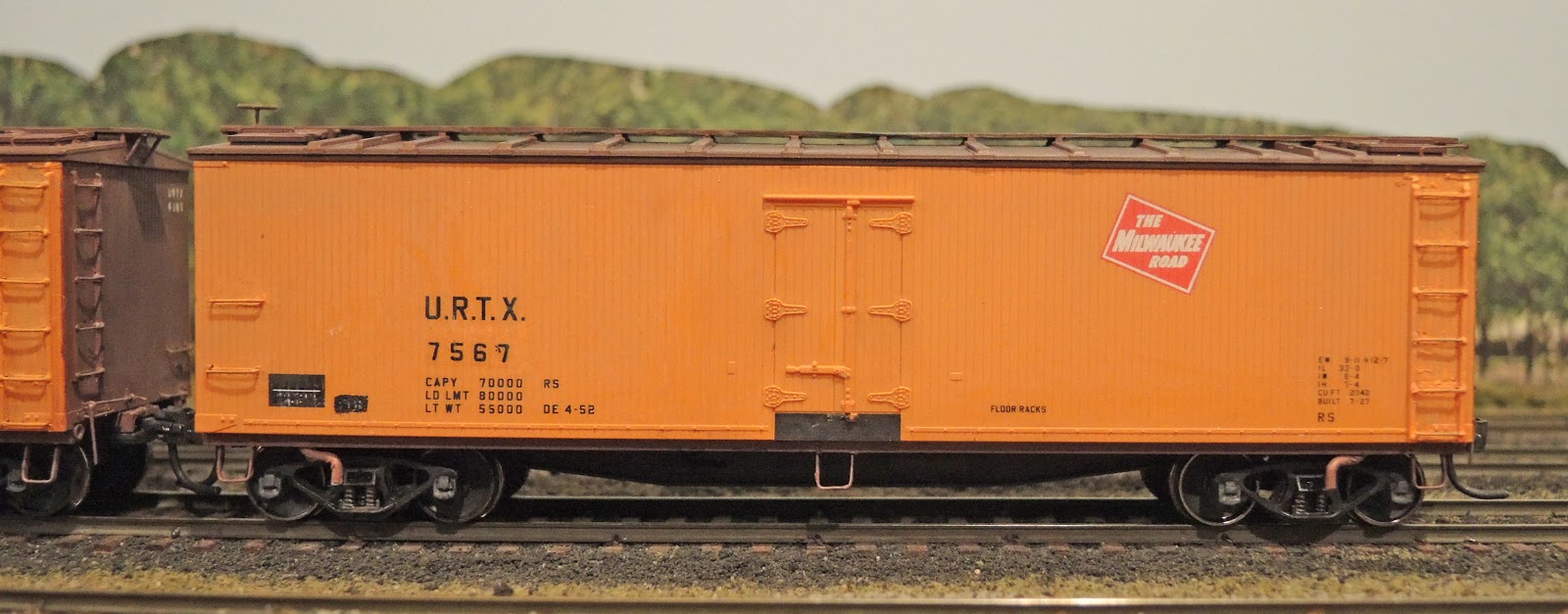
Union Refrigerator Transit Lines wood refrigerator car, URTX 7567, assigned to series 7000-7699, was built in 1927 by American Car & Foundry and leased to The Milwaukee Road.  A photo of URTX 7579 appears on page 151, in Steam Era Freight Cars Reference Manual, Volume Three: Refrigerator Cars, published by Speedwitch Media in 2017. I used this photo as a guide for my build and upgrade of this plastic kit purchased from 5th Avenue Car Shops  who had Accurail  produce the car using their 4800 series wood refrigerator.  The car was painted and lettered except for car numbers which have to be applied by the modeler  using decals provided in the kit.

I began the assembly and upgrade of this car on the underbody by installing the brake components after drilling them with a #79 drill for piping  to be added later.  The kit provides plastic pins to attach the trucks and molded on pins on coupler pocket covers to attach them to coupler pockets.  I use neither.  I cut the molded on pins from the back of the coupler pocket covers and use the remaining spot to drill and tap a 2-56 hole for mounting with screws.  Next the truck bolster kingpins were drilled and tapped for 2-56 screws.  Kadee #148 “whisker” couplers were installed in the coupler pockets and Accurail #150, 2-56x3/16” screws were used to attach the covers.  The Accurail trucks after slight modification, including removing the brake shoes, were installed with Athearn #99002, 2-56x1/4” round head screws.  Next the kit provided car weight was attached with Permatex adhesive sealant clear RTV Silicone which weighted the car to 4 ounces.  With these tasks complete, I glued the underbody to the car body.

Underbody complete to insert into car body
 
I now turned my attention to the car body details.  The first upgrade step was to carve off all the car molded on grab irons to be later replaced with wire ones.  I followed this step by carving off all ladder rungs leaving only the ladder side rails.  The carving was done with a Xacto number 5 handle with a number 17 Xacto blade ground to the shape  I like for carving off molded on details.  If you do not want to grind a blade, you could use a number 17 blade with only the corners rounded to prevent gouging; however, I believe a much better solution is to buy the micro knife handle #81067 and surgical blades #61, #81084 and #62, #81085 from MicroMark.  I use these micro handles and blades to do final cleanup of carved off areas after using the Xacto blade.

Knives used for carving off molded on grab irons and ladder rungs
(click on photos to enlarge)
 
Ground tip like micro surgical blade

 
After the grab irons and ladder rungs were carved off, the areas were brush painted using Vallejo Model Color Light Orange #70.911 for the sides and Mahogany Brown #70.486 for ends and roof.  Both colors are an excellent match for the original paint used by Accurail. While the car was set aside for the paint to dry, the running board was milled thinner, from .040” to .025”, using a Dennis Storzek technique described in his article, “5 boxcar improvements”, in April 1982, Railroad Model Craftsman, on page 84.  Once milling was complete edges were touched up with the Vallejo Mahogany Brown.  Of course, there are others options for a scale running board such as scratch-building one from scale lumber or purchasing a laser cut  one.

Milling setup and jig using Dremel tool.
 
After paint was dry, the milled running board was installed.  New running board extension support brackets were made from Evergreen #8102, 1x2” strip styrene.  I drilled new holes using a #79 drill to receive corner grab irons. The roof corner  grab irons were bent ( see bending grab irons under labels on this blog) from Tichy Train Group (Tichy), #1101, .010” diameter phosphor bronze wire (PBW) and installed with Yarmouth Model Works etched eyebolts for corner legs.  New wire grab irons  were painted with Vallejo Mahogany Brown.


I continued the car body upgrade by drilling new holes using a #79 drill to receive grab irons on sides and ends and ladder rungs.  The molded on rung fasteners on the molded on ladder side rails were used as a guide to drill holes next to them for wire ladder rungs.  Ladder side rails were shortened to better match prototype photo.  Next I bent straight grab irons  from Tichy, #1101, .010” diameter PBW ( see bending grab irons under labels on this blog) and installed them.   After install of straight grab irons was complete, I bent the ladder rungs which are straight grab irons installed for rungs between the ladder side rails.  New straight grab irons were painted Vallejo Model Color Light Orange on sides and Mahogany Brown on ends.  To complete the car body sides upgrade, the molded on sill steps were cut off and A-Line #29000, sill (stirrup) steps were installed and painted Vallejo Mahogany Brown.


The “B” end upgrade was next.  I began by cutting off the molded on bulge on the bottom of the brake step off.  Brake step support brackets, Tichy brackets from set #3013, were installed.  A Sunshine Models resin retainer valve from the parts box was installed followed  by installing a retainer line and bracket made with Tichy #1100, .008” diameter PBW.   The brake  shaft step is molded with a filled in center rather than being open as it should be. To create an open brake shaft step  I drilled the center of the step with a 2-56 drill and finished forming the opening with a broach and file.  Maybe cutting it off and replacing it with a A-Line #29000, sill ( stirrup) step would have been easier.    A brake shaft, Tichy #1102, .015” diameter PBW, substituted for the .020” diameter kit provided brake shaft, was installed.  The brake shaft  had a Tichy brake wheel, set #3013, mounted on it replacing the thicker kit provided one.  A number #76 drill was used to drill a hole for brake shaft to go through in the lower portion of the brake shaft step prior to install. A brake shaft bracket was made with Tichy #1101,  .010” diameter PBW and installed.  Uncoupling levers bent from Tichy #1106, .0125” diameter PBW were installed with eyebolts I bent from  .010” diameter brass wire ( for bending technique see uncoupling levers under labels on this blog).  Again all new parts installed were painted with Vallejo Mahogany Brown.


Final cleanup still to be done
 
 
With car body details added, I added underbody details.  Piping from air reservoir to control valve, Tichy #1101, .010” diameter PBW and  pipe from back of brake cylinder to control valve, Tichy #1106, .0125” diameter PBW wire were installed. Next a train line using 26 gauge, .018” diameter, floral wire was installed with couplings made with MEK Goop.  The train line holes were drilled in bolsters and cross ties with a 4” drill made from .032” diameter piano wire.  A dirt collector, Tichy Set #3013, was now installed connecting its molded on pipe to the train line with a connecting tee made from MEK Goop.  Brake levers made from Evergreen #8108, 1x8” and #8106, 1x6” strip styrene were installed. Brake rodding, Tichy #1106, .0125” diameter PBW was connected to brake levers with half a Tichy #8021, turnbuckle.   Chain between brake cylinder and rod is A-Line #29219, 40 links per inch.  Underbody added details were painted Vallejo Model Color #70.862, Black Grey.


Ice bunker drains have not yet been added
 

The final details added were the ice bunker drains.  The drains,  bent from .040” diameter 24 gauge floral wire, were installed and painted Mahogany Brown.

Upgrade was now complete except for decals.  Time to add numbers to car sides and  reporting marks and numbers to ends with decals in kit.  First,  Model Master 4638, Clear Gloss Acryl  was applied to area were decals were to be applied.  Once  dry, decals were applied using MicroScale MicroSol.  Decals were allowed to dry overnight before I sprayed the entire car body with Model Master 4636 Flat Clear Acryl rather than just coating the applied decal areas.

Wood refrigerator URTX 7567 is now in service serving customers of the Minneapolis & Northland Railroad Company.

Car out of paint shop on Dawkins siding


Car weathered with Pan Pastels


Thank You for taking time to read my blog.  You can share a comment in the section below if you choose to do so.  Please share the blog link with other model railroaders.
Lester Breuer


Friday, September 14, 2018

Uncoupling Levers - Bending your own

When I decided I was going to bend uncoupling levers for my freight car models I felt I needed some basic information about the uncoupling lever to accomplish the task. I began my information search with the definition. The uncoupling lever or uncoupling rod (also called a cut lever) definition in the Dictionary Of Car Terms, in the 1949-1951 Car Builders’Cyclopedia published by Simmons-Boardman Publishing Corporation, “a rod with a bent handle forming a lever, usually attached to the end sill, by which the lock of the automatic coupler is opened and the cars uncoupled without going between them. The lever proper is the part attached to the rod and operating the unlocking mechanism, but in the case of freight cars the lever and rod are generally made in one piece.” The definition has remainder unchanged since the 1922 Car Builders’ Cyclopedia with the exception of the word “iron” in front of the word “rod” being omitted.

The definition is not enough to begin bending an uncoupling lever as it does not provide the dimensions or mounting location data. For that data I had to look in the safety appliances: A.A.R. Standards section of the 1949-1951 Car Builders’ Cyclopedia. Here I found two uncoupling levers are required. The handle, of an approved design, shall not be more than twelve (12) inches nor less than nine (9) inches from the sides of the car. Ends of the handles shall extend not less than four (4) inches below the end sill, or shall be so constructed as to give a minimum clearance of two (2) inches around the handle. Minimum drop of the handles shall be twelve (12) inches; maximum, fifteen (15) inches over all.

I still needed to know what handles, of an approved design, were used. I found the following photos in the 1941-1951 and 1953 Car Builders’ Cyclopedias in the Standard section and the Couplers And Draft section.  The photos show the two basic rod types of uncoupling levers: top or bottom.

Top mounted uncoupling lever
(Tap or click on this and other photos to enlarge)

Bottom mounted uncoupling levers
Another handle type of bottom uncoupling lever

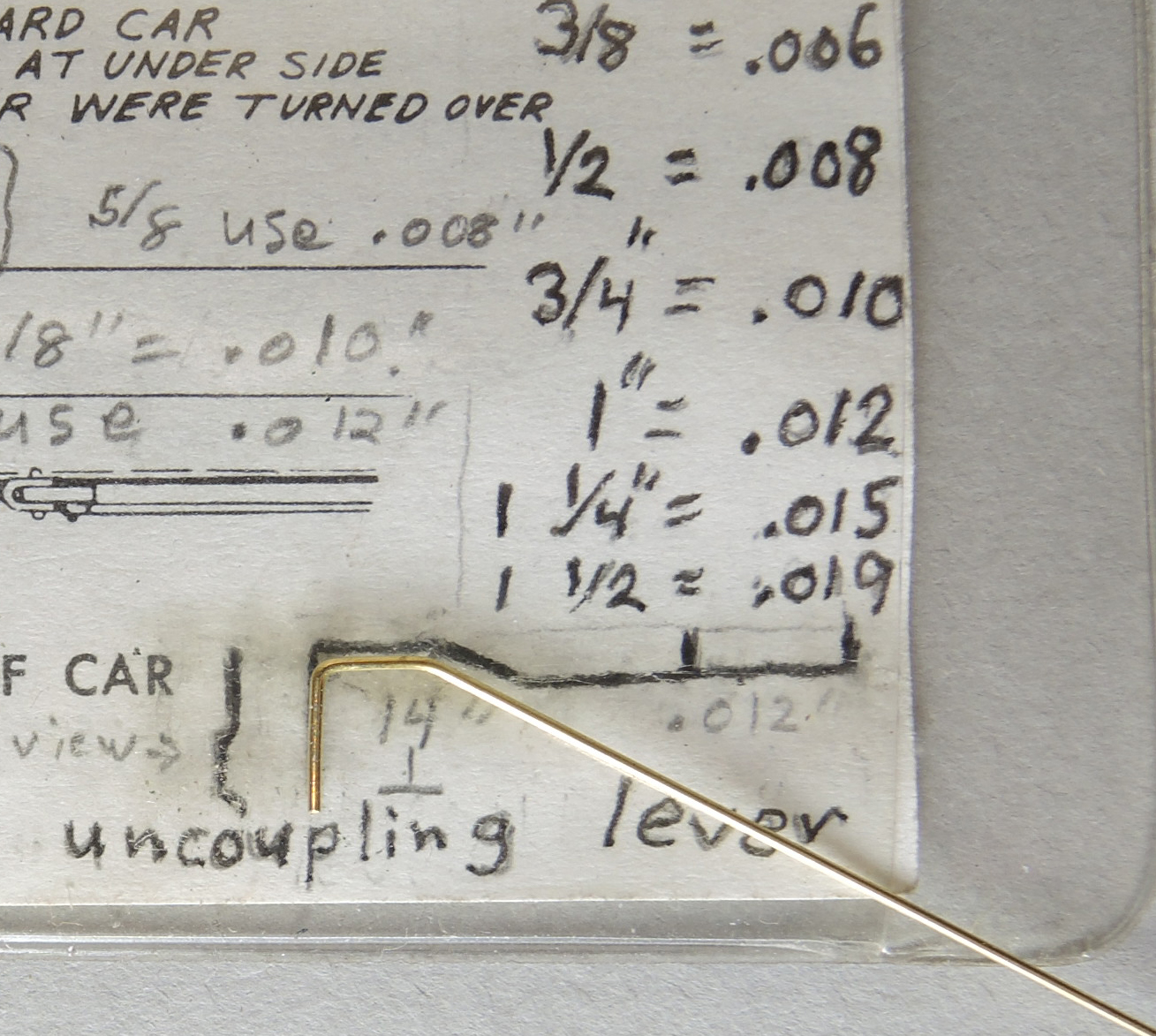
Now I had the necessary data and photos to help me bend and locate uncoupling levers ( cut levers) on my freight cars. I drew a simple diagram to help me with the bending. I have drawn a second diagram with the actual HO Scale dimensions to help you draw a diagram to bend the uncoupling levers. Another way to draw the lever pattern on paper is to take an uncoupling lever in your parts box and trace around it.

Basic uncoupling lever pattern in lower right corner


The circled letters are points pliers placed for various bends.


Once you have a diagram, choose the wire size you wish to use for the uncoupling lever. I prefer .012” Detail Associates brass wire, #2504, or .0125” Tichy Train Group phosphor bronze wire, #1106. You will also need a needle nose plier to use to make the bends in the wire to form the uncoupling lever.

To start an uncoupling lever you make a right angle in the wire a scale 15” or longer from the end of the wire as you can cut it to final desired length later (A on the diagram). You lay the wire with the right angle bend on the diagram and grab it with the plier at point B on the diagram and bend wire downward at an angle while holding it on diagram. Move the plier to point C on the diagram and make an upward bend while holding wire on the diagram. The final step is to move the plier to point D and bend the wire upward until you have bent a right angle.  You have now bent an uncoupling lever. With practice, you soon will be able to bend two uncoupling levers in a very short time.


Plier at point B and wire portion beyond plier is bent downward

Wire bent downward

Plier closed on wire at point C and wire bent upward

Wire to right of plier bent upward

Plier moved to point D for final bend

Finished uncoupling lever


Finished uncoupling lever wire to be cut off above plier


Once you have two uncoupling levers bent you are ready to attach them to your freight car. You will need uncoupling lever brackets to do so. In a resin kit the uncoupling lever brackets may be cast in resin that you have to cut out of a resin cast parts sheet and attach to the car. I have found these break easily and no longer use them. I use eyebolts made by Detail Associates, #2206, or etched brass ones from Yarmouth Model Works, with or without shoulder or eyebolts I bend myself for brackets.  Another bracket type I use when mounting bottom type uncoupling levers is an etched bracket made by Yarmouth Model Works, #507, you cut out of an etched brass fret and bend into shape for mounting.  Yet one more bracket I use is one scratch-built from an Evergreen, #291, .060 styrene angle.  The latter two type brackets are used with bottom mounted couplers on the left side of the freight car and the right angle bend at point D on uncoupling lever is inserted into a hole drilled in the coupler box.  You will have to decide which of these brackets or other brackets of your choice to attach the uncoupling lever to your freight car.


Top type uncoupling lever

Bottom type uncoupling lever
Bottom type coupler with right angle end mounted in coupler box.


Thank You for taking time to read my blog. You can share a comment in the section below if you choose to do so. Please share the blog link with other model railroaders.
Lester Breuer

Tuesday, August 28, 2018

Grab Irons - Bending Your Own Custom Grab Irons

All freight car types we build have grab irons ( also called handholds).  I wanted to bend my own custom grab irons so I thought I would gather some basic data as to size and application.  My research began by looking up grab irons in the Dictionary of Car Terms, section one, in the 1949-1951, 18th edition, Car Builders’ Cyclopedia, published by Simmons-Boardman.  It states to see “handhold”.  When I looked up the term “handhold “ I found, see “Safety Appliances” which it defines as devices required by the Interstate Commerce Commission to assure safety in operation of cars.  I turned to the Safety Appliances, section 13, to find additional information.  Here, I read: “the “Safety Appliance Act,” established by act of Congress, was approved April, 14, 1910.   In 1911 the United States Safety Appliance Standards, as contained in the order of the Interstate Commerce Commission, dated March 13, 1911, were adopted as a standard.”  These rules have been added to and changed from time to time. One change adopted in 1932 for box and other house cars added the second grab iron on the sides.
  

The standards identify the type of appliance to be used ( in my case box car grab irons), the number required on each car, their location, manner of application and the minimum or maximum (or both) dimensions.  While standards have been established for each type of freight car those pertaining to box and other house cars embrace all the rules.  I found data for side handholds, horizontal end handholds, vertical end handholds and roof handholds.  From the data provided for each type, I found each type to have the following: dimensions -minimum diameter, five eights (5/8) of an inch, wrought iron or steel, ,minimum clear length, sixteen (16) inches, preferably twenty-four (24) inches, and minimum clearance , two (2), preferably two and one-half ( 2 1/2) inches.  All types have other specifics and exceptions.   One such exception, end handholds fourteen (14) inches in length may be used  where it is impossible to use sixteen (16) inches in length.   I will not cover the specifics listed for each type here. If you wish read all specifics of each type as well as those of other freight car types you can find them in one of the Car Builders’ Cyclopedias.  Two other out of print sources that contain the safety appliance standards data are Train Shed Cyclopedia No. 81, Freight Car Const. Details, Safety Appliances & Trucks from the 1943 Car Builders’ Cyclopedia published by Newton K. Greg or Freight Car Design Manual, published by Wm. K. Walthers in 1946.
   

Out of print publications with Safety Appliances
(click or tap on any photo to enlarge)
  

Armed with my research data, I  was able to bend custom straight, drop type or roof ( corner ) right-angle grab irons (handholds).  Using my research data I first had to choose a wire size for the grab irons I was going to bend.   The standards specified five eights 5/8 of an inch which translates to .008” diameter in HO scale which, in my opinion, is too fragile on a HO scale freight car running on an operating railroad.  Additional research in the hobby press found majority of modelers use .010, .012 or .0125” wire for grab irons.  I am comfortable using any of these sizes; however, my preferred size is .0125” diameter.  Brass wire sizes except for .0125” are available from Details Associates  and Tichy Train Group has them available in phosphor bronze wire except for .012” diameter.
  

Note hair pin used to hold package closed
   
To bend a grab iron using the wire size chosen I need some some tools: pliers, wire cutters and a bending jig.  The jig is made from .040” x sheet styrene with holes drilled from the right edge to bend grab irons of  various length. The holes were added when a certain size grab iron was needed.


To make the jig I used a piece of .040” sheet sheet styrene cut to 3/4” x 2 1/2.”  A hole, using a #80 or #79 drill, was drilled in the jig for each grab iron size when needed.  A caliper was used to obtain the length measurement of a grab iron needed and transferred to the jig by holding the caliper so one bar edge touches the edge of the jig and a mark is placed at the point of the other bar on the jig.  The mark is used to drill a #80 or #79 hole.  If you do not have a caliper, a divider, or a piece of paper with marks showing the grab iron length can be used to transfer the grab iron length measurement to the jig.


Caliper used to mark hole for drilling
 
I bend a straight grab iron by first making a right angle bend in a chosen wire size creating the first leg.  The leg is inserted in the hole of the jig with remaining wire extending over the side of the jig.  Using a plier, you grab the wire at the edge of the jig with the plier held in a horizontal position to the jig.  With plier closed on the wire, I lift the wire out of the jig and bend down making  a second right angle bend, creating the second leg of the grab iron parallel to the first leg.  I now have bent a straight grab iron ( U shape) with the length of grab iron needed.  Now the second leg is cut off , equal in length to the first leg, from the starting wire with the wire cutters.
    

Right-angle bend in wire
 
Pliers held horizontal to jig
 
Wire lifted off jig
 
Finished straight grab iron


I can also use my jig to bend a roof (corner) right-angle grab iron.  I make the first right-angle bend in the wire to create the first leg and insert it in the jig.  I take pliers and hold them in a vertical position when I close on the wire at the edge of the jig.  With pliers closed on wire, I lift the wire out of the jig and bend the wire sideways to create a right angle with the pliers to form the right-angle corner grab without the second leg.  The grab iron is now put back into the jig with the formed right-angle corner on the jig.  I now take the pliers and grab the wire at the edge of the jig with the pliers held in the horizontal position to the jig.  I take the grab iron out of the jig and bend downward to creat the second leg of the corner grab iron.  Again use the wire cutters to cut the second ledge to equal that of the first.  I now have bent a right-angle corner grab iron that per safety standards is to have extra (third) leg which is securely fastened to car at the point of the angle.  I use an eyebolt, commercial or one I bend, to make this third leg.
  
Pliers held vertical to jig
 
Bend wire sideways to create right-angle

Right angle placed back on jig
 
 
Finished roof (corner) right angle-grab iron
 
Roof (corner) right-angle grab with eyebolt for third leg

 
To bend a drop grab iron I first bend a straight grab iron and insert the completed grab iron into a square jaw pliers to the depth, marked with a marker or tape on the plier jaw, I want the drop grab iron portion to be.  I close the plier jaw to hold the grab iron and bend the exposed  two legs down.  I have bent a drop grab iron.  I find this method much faster than using a simple styrene jig I have made and used in the past.

The jig was cut from sheet styrene, the thickness matching the portion of the drop grab iron, and had two holes drilled in line into which a straight grab iron could be inserted (see the top portion of the jig photo).  Once the straight grab was inserted the legs on the back side were bent flat against the jig.  Again, a drop grab iron is formed. 
   

Straight grab iron inserted into square jaw plier
 
Finished drop grab iron


Of course, you can buy manufactured grab irons from several model manufactures; however, they are available only in certain sizes.   If you choose to use the manufactured grab irons you still can use the methods I have shown you here to bend the custom sizes when needed.
   

When grab irons are installed the safety appliances standards state they need to have a minimum clearance , two (2), preferably two and one-half ( 2 1/2) inches from the surface of the car.  I made a clearance jig from .022” styrene to help me get the clearance correct when I install the grab irons I have made.


If you have not made grab irons (handholds) before reading my blog I hope my methods I have described here will help you to do so.


Thank You for taking time to read my blog.  You can share a comment in the section below if you choose to do so.  Please share the blog link with other model railroaders.
Lester Breuer