Illinois Central (IC) steel 1937 AAR Autocar 36670 began as a composite kit build. I call it a composite kit build as Resin Car Works (RCW) mini-kit 6.1, first available at 2024 Naperville RPM (Railway Prototype Modelers), provided parts to be installed on a InterMountain, (IM)kit 408XX, plastic kit provided by the modeler. In my case, I chose InterMountain kit 40899, an undecorated box car kit with the required 10 foot 6 inch inside height.
 |
| RCW mini-kit on left and IM kit 40899 (Click or tap on this or any image to enlarge) |
The prototype history in downloaded kit instructions tells us the prototype was one of 1000 cars built by Pullman-Standard, series 166000-166499, and American Car & Foundry (ACF), series 166500-166999, in 1937. In October of 1938, 500 cars were renumbered to 35500-35999 due to being fitted with Evans Auto Loading Devices. In 1941, these same car were again renumbered to 36500-36999 when the loading devices were altered.
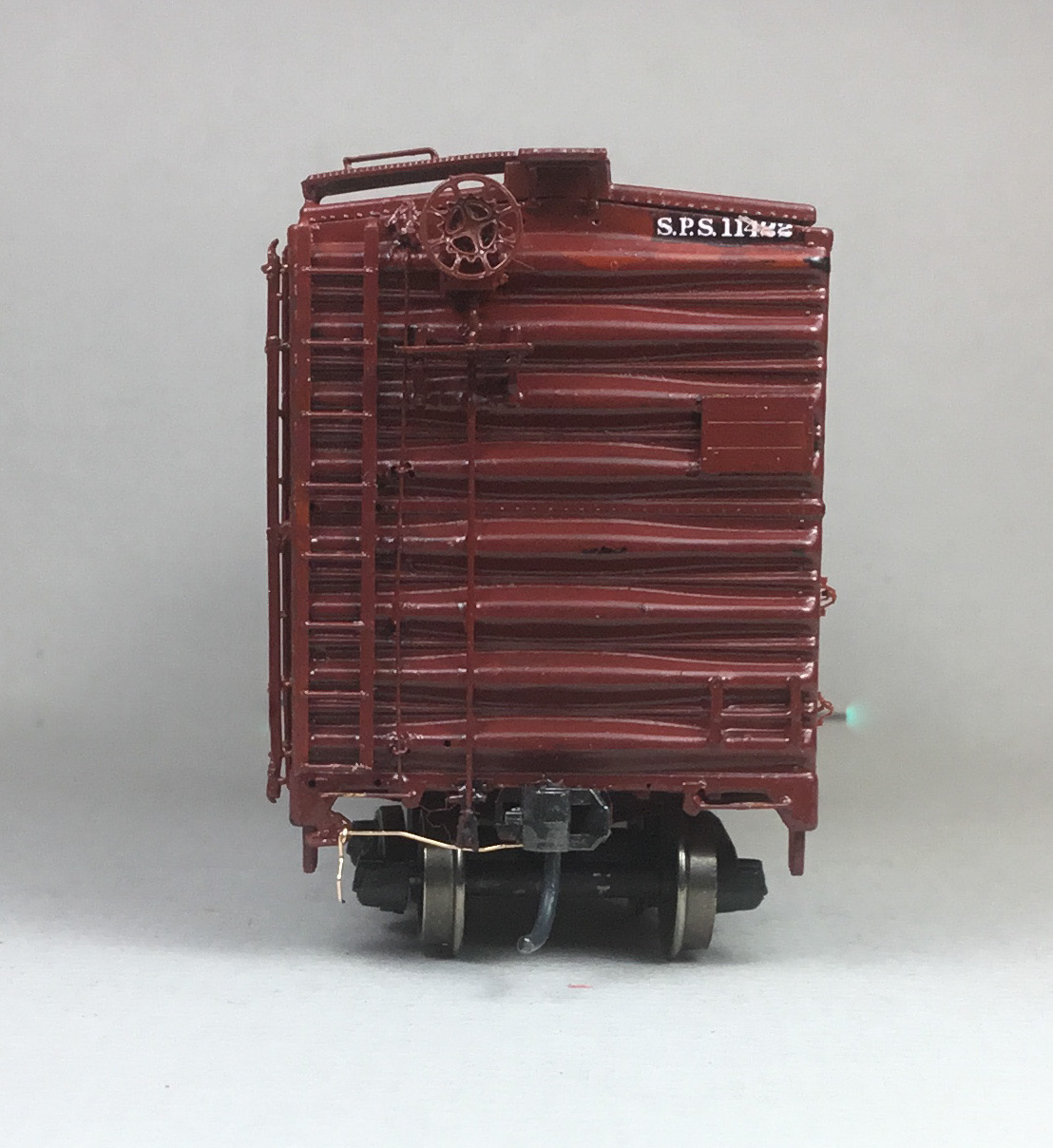
In addition, the prototype history in the kit instructions tells us, “These automobile cars had a 40’ 6” IL, a 9’ 2” IW, and an initial 10’ 5” IH. The cars were equipped with staggered double 6’ wide Youngstown corrugated steel doors… Additionally, they had “Hutchins” rigid riveted raised panel roofs, Dreadnaught ends consisting of two panels configured in a 5 over 5 corrugated arrangement, Universal XL hand brakes, and AAR Scullin 40-ton trucks. The bill of lading for the ACF cars noted that they were painted #11 Maroon on the sides, ends and doors. The roof and underframe were coated in black car cement. The trucks were painted black… The wood running boards…”
 |
| Illinois Central 166199 Resin Car Works kit instructions. |
A car diagram from an Illinois Central Diagram book is also provided here for your review to confirm or provide additional information.
 |
| Illinois Central Diagram Lester Breuer Collection |
Onto the build. I began the build using the InterMountain car body and installing the InterMountain roof (not glued until car weighted) and the resin 5/5 ends from the Resin Car Works (RCW) mini-kit. To weight this or any car I want the truck and couplers installed to have them included in getting to the car weight of 3.8 ounces. Therefore, I went to the underbody.
On the underbody before I installed the trucks and couplers I had to modify the underframe. Why? The InterMountain underframe is designed for a single door car and must be changed for a double door car. The crossbearers, currently located at the edge of the door opening, must be moved to the crosstie location on the outer side of them and the crossties moved to the current position of the crossbearers. The reason for this change is the crossbearers need to sit at the outer edge of the doors. A single edge razor blade was used to cut each off and installed in the proper position.
 |
| IM underframe before modification. |
 |
| IM underframe after modification. |
As can be viewed in the photo above, bolster center plates and coupler box holes were drilled and tapped for 2-56 screws. Kadee #262 coupler boxes with Kadee #148 couplers inserted (not in kit) as were the Tahoe Models trucks provided in RCW mini-kit with InterMountain metal 33 inch metal wheels (modeler supplied) inserted, were installed with Fastenal 2-56 x 1/4 inch Fastenal screws. The gap between the coupler box and bolster was filled with a piece cut from an Evergreen I-beam. The car was weighted to 3.8 ounces using Harzole Adhesive lead free car wheel weights and roof was now glued in place with MEK.
 |
| Leas free car wheel weights. |
 |
| Trucks and couplers added. |
 |
| Car body ready for detail install. |
Normally in a build I first add the ladders next; however, in this build to finish the car body I made the sill changes needed next. Rather than use the resin parts to make sill changes I used Evergreen strip styrene, #133 .030 x .060 for the upper portion and #135 .030 x .100 for the lower part using the resin cast parts as masters. Using strip styrene provided clean lines without flash removal or sanding and the need for an adhesive to glue resin to styrene body.
Since I was on the side I also installed the double doors provided in the kit. Install of the double doors also required making door guides on left side of the double doors using Evergreen #133, 1 x 3 strip styrene.
 |
| Side sill, doors installed and door guides made. |
With the car body completed for additional details the kit provided Plano etched ladders were bent with an UMM-USA bender and installed. The Plano etched ladders had to shortened to match prototype best done before bending; however, since I bent them first I cut them to proper length via cutting disk in a Dremel Motor Tool. After install of ladders, I installed the InterMountain running boards with Testors tube cement.
 |
| UMM-USA bender |
 |
| Plano etched ladders installed. |
 |
| Plano etched ladders installed. |
With running boards installed, I installed the roof grab irons bent from Tichy Train Group (Tichy) #1101, .010 phosphor bronze wire (PBW) using Yarmouth Model Works (YMW) etched eye bolt without shoulder for corner leg. To complete longitudinal running board install, I installed an etched YMW bracket #220 on the ends.
 |
| Roof grab irons and running board end brackets installled. |
After running board bracket install on the “B” end I continued to install the detail parts as follows:
- Brake step, kit provide Tichy set #3013
- Brake step brackets, kit provided Tichy set #3010
- Brake housing, InterMountain kit (hole enlarged with #56 drill for Kadee brake wheel)
- Brake wheel, Kadee Universal #2033
- Bell crank, kit provided Tichy set #3013
- Chain, brake housing to brake rod, InterMountain kit
- Brake rod, Tichy #1102, .015 diameter phosphor bronze wire (PBW)
- Brake rod clevis, to attach brake rod to bell crank, InterMountain kit
- Retainer valve, Tichy AB brake set #3013
- Retainer line and brackets, Tichy #1100, .008 diameter PBW
- Placard boards, kit
- Grab irons (handhold, end) bent from Tichy #1101, .010 diameter PBW
 |
| B End details installed. |
Now back to the sides to complete the install of Kadee bracket grab irons #2251 using InterMountain provided holes requiring the lower left and upper right pin on the grab iron as looking from the front to be cut off with a PBL nipper. Cutting off these pins also allows one to have a little wiggle room to get the hand hold straight. Other needed details to match prototype installed were the A-Line sill steps #29001, style B and tow loops bent from Tichy #1114, .020 PBW. And, fasteners made on sill with MEK Goop.
 |
| Bracket grab irons installed. |
 |
| Tow loop, fasteners and sill step installed. |
Next it was back to the ends where uncoupling levers bent from Tichy #1106, .0125 diameter PBW with bracket made from Evergreen #291, .060 angle glued to poling pocket plate and trimmed to shape with PBL nipper.
 |
| Uncoupling lever installed. |
 |
| Uncoupling lever installed. |
With the install of uncoupling levers the car body work was complete. Now, onto to the underbody work. The brake components were drilled to accept piping with #79 drill and were installed with other parts as follows:
- Brake cylinder lever, cut from Evergreen #8108 strip styrene
- Floating (cut) lever, cut from Evergreen #8106 strip styrene
- Brake lever hangers, plastic grab irons
- Brake cylinder, kit
- Brake cylinder piston, Tichy, #3013 AB set in kit
- Brake cylinder bracket, from my parts box
- Control Valve (AB), Tichy set #3013 in kit
- Control Valve bracket, Tichy set #3013 in kit
- Air reservoir, Tichy AB set #3013 in kit
- Air reservoir mounts, scrap plastic
After setting overnight for CA to fully set, piping and brake rods were installed as follows:
- piping control valve to air reservoir, Tichy #1101, .010 diameter PBW
- Pipe from brake cylinder to control valve, Tichy #1106, .0125 diameter PBW
- Brake rods, Tichy #1106, .0125 diameter PBW
- Brake rod clevises, MEK Goop (plastic melted in MEK)
- Dirt collector, Tichy AB set #3013
- Dirt collector pipe to train line, scrap plastic rod
- Chain, A-Line #29219, black 40 links per inch
 |
| Underbody details installed. |
Illinois Central double door autobox car 36670 was ready for the paint shop. In the paint shop the car body was cleaned with a cotton makeup swab dipped in 91% isopropyl alcohol. When the car body was dry it was air brushed with Vallejo Grey Surface Primer 70.601. Photos of IC 36670 in Surface Primer taken before uncoupling levers installed.
 |
| Right side in Surface Primer. |
 |
| Left side in Surface Primer. |
When the primer coat was dry, the car body was airbrushed Polly Scale Wisconsin Central Maroon F414200 (no longer manufactured) and the underbody was airbrushed Vallejo Model Color Black Grey 70.862,
 |
| Car body airbrushed Wisconsin Central Maroon. |
 |
| Car body airbrushed Wisconsin Central Maroon. |
 |
| Underbody airbrushed Black Grey |
Again when dry, the car body was airbrushed with Vallejo Gloss Varnish 70.510 for a gloss base for the kit decals. After drying overnight, kit provided decals were applied. I used a prototype photo of Illinois Central auto box car for decal location of "MainLine of Mid-America" slogan that replaced "Automobile."
Decals were soaked off in distilled water and applied to the car body where MicroScale Micro Set had been applied with a brush. After the decal was applied in the Micro Set and positioned the edges had MicroScale Micro Sol applied. Any excess solution was sucked away with the torn edge of a paper towel. Again when dry, car body sprayed with Vallejo Gloss Varnish #70.510 to better hide edges of decals and protect decals during handling. Again when dry, the car body was sprayed with Model Master Acryl #4636 (no longer manufactured), to protect decals and provide a flat finish for weathering.
 |
| Kit decals applied. |
 |
| Kit decals applied. |
 |
| Kit decals applied. |
One more step before putting Illinois Central auto box car 36670 in service was to weather the car with Pan Pastels. Pan Pastels and tools used can be seen in the photo below.
 |
| Pan Pastels and applicators used to weather Illinois Central 36670. |
And, the weathered car.
 |
| Illinois Central 36670 weathered. |
 |
| Illinois Central 36670 weathered. |
 |
| Illinois Central 36670 weathered. |
Illinois Central auto box car 36670 was ready for service on the Minneapolis & Northland Railroad Company, The Lakeland Route, “Serving today, Shaping tomorrow.” A car card was made for IC 36670, the final step to put the a car in service on the Minneapolis & Northland Railroad Company Railroad.
 |
| IC 36670 spotted on Team Track at Bass Lake Jct. in Minneapolis, Minn. |
 |
| IC 36670 spotted on Team Track at Bass Lake Jct. in Minneapolis, Minn. |
 |
| IC 36670 spotted on Team Track at Bass Lake Jct. in Minneapolis, Minn. |
I want to say, “Thank You” to Resin Car Works for the excellent kit instructions obtained via download from the Resin Car Works website.
Thank You for taking time to read my blog. You can share a comment in the section below if you choose to do so. Please sign your comment with your name if you choose to leave one. All comments are reviewed and approved before they appear. Please share the blog link with other model railroaders.
Lester Breuer
.